
Temps de lecture : 7 minutes
Written by Violette Demain- Article published in March 2023, updated in May 2026
In summary
- Stakeholders (orstakeholders) refer to all actors who participate in the economic life of a company, closely or remotely
- We distinguish between internal stakeholders (employees, managers, shareholders) and external stakeholders (suppliers, customers, communities, NGOs)
- In CSR, suppliers have become a priority stakeholder due to the duty of vigilance and the CSRD
- Engaging stakeholders in the CSR approach is an increasingly strategic and regulatory challenge
- Two concrete levers: evaluate suppliers (Scoring by Positive) and structure the overall CSR approach (Label Positive Company®)
Positive Company is the first CSR label to involve all stakeholders of the company in its labeling program. A 360° vision of CSR, placing them at the heart of the reflection. However, for many, the term "stakeholder" remains vague. Highlighting essential players in the life of a company..
Definition and distribution
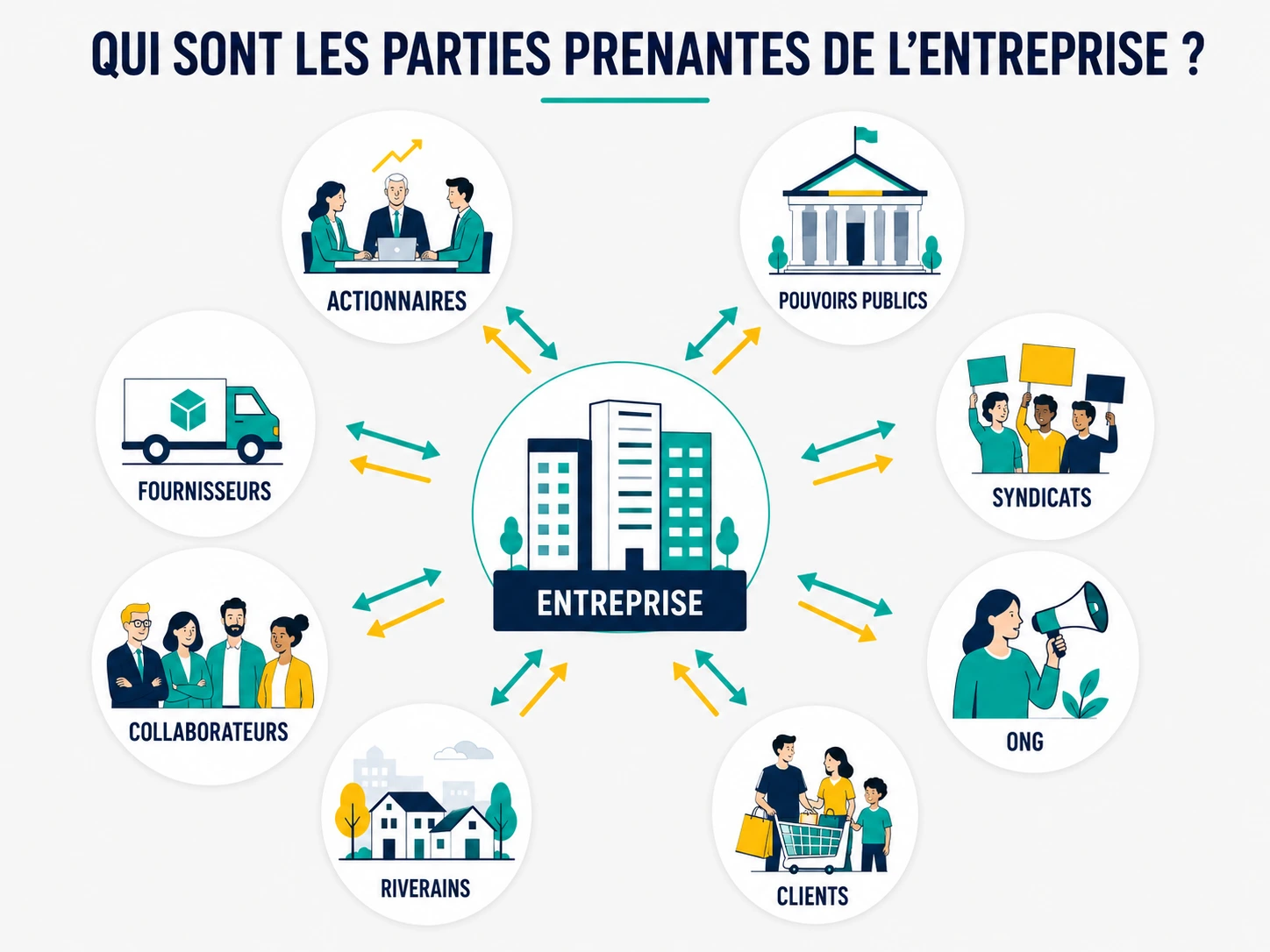
Also known asstakeholders, in English, the stakeholders of a company gather all the actors participating, closely or remotely, in its economic life. This includes, among others, customers, suppliers, and employees. Stakeholders are therefore all individuals with an interest in the company.
We distinguish two main types of stakeholders:
- Internal stakeholders: executives, employees, shareholders, unions, etc..
- External stakeholders: suppliers, customers, local authorities, states, NGOs, associations, media, etc.
This distinction is important because the expectations, engagement levers, and dialogue modalities fundamentally differ between these two categories.
Stakeholders and CSR
The theoristR. Edward Freemanargues that a responsible company must be transparent with its stakeholders and involve them in its value creation, as they are responsible for its prosperity. Today, this postulate is integrated into all CSR frameworks — and it is gradually becoming a legal obligation.
Three regulatory texts have profoundly transformed the relationship between companies and their stakeholders in recent years:
The duty of vigilance lawrequires large companies to identify and prevent CSR risks related to their activities and those of their suppliers and subcontractors. External stakeholders — particularly suppliers — are now at the heart of regulatory compliance.
The CSRD directiverequires affected companies to publish non-financial information covering their entire value chain. This involves collecting data from their suppliers, partners, and, in some cases, their customers.
The CS3D directivegoes even further by imposing due diligence on human rights and the environment beyond tier 1 of the supply chain.
As a result, stakeholder mapping and engagement are no longer just good CSR practices — they have become a reporting and compliance obligation for an increasing number of companies.
Suppliers: the priority external stakeholder
Among all external stakeholders, suppliershold a central placein the CSR strategy of the contracting authorities. And for good reason: they often represent more than 50% of a company's CSR impact — in terms of carbon emissions (scope 3), working conditions in the supply chain, or environmental practices.
Yet, suppliers often remain the least known stakeholder to CSR and purchasing departments. Data is scattered, practices are heterogeneous, and evaluation methods are poorly structured.
Why suppliers have become essential:
- Scope 3 (indirect emissions related to purchases) accounts for an average of 70% of a company's carbon footprint
- The duty of vigilance requires documenting CSR risks with direct suppliers and subcontractors
- The CSRD requires comparable and reliable data across the entire value chain
- Financial stakeholders (investors, banks) are increasingly integrating these criteria into their decisions
How to evaluate suppliers as CSR stakeholders?
Supplier CSR evaluation involves measuring the environmental, social, and governance practices of business partners through a structured questionnaire, supplemented or not by supporting documents. It provides a clear and consistent view of the panel, prioritizes risks, and engages in constructive dialogue with suppliers.
💡 Scoring by Positive®: structure the CSR evaluation of your suppliers
Scoring by Positive is the CSR supplier evaluation solution designed for clients: a custom framework based on ISO 26000 and the CSRD,free for your suppliers, with human support throughout the deployment.
"It is the personalized approach that convinced us — there are no other tools for e-commerce." Juliette Dubois-Tailliez, CSR Project Manager, La Redoute
Discover Scoring by Positive® Learn moreStakeholders and ISO 26000
The ISO 26 000 standard establishes, for the first time, a framework for companies wishing to operate sustainably. It defines a company's responsibility regarding the impacts of its decisions and activities on society and the environment, resulting in a transparent and ethical behavior that:
- Contributes to sustainable development, the health of individuals, and the well-being of society
- Complies with current legislation and international standards
- Is integrated throughout the company and implemented in its relationships
ISO 26000 places thedialogue with stakeholdersas one of the 7 fundamental principles of social responsibility. It particularly recommends mapping stakeholders, identifying their expectations, and integrating this information into strategic decisions.
Dialogue and stakeholders
Indeed, establishing a dialogue with its stakeholders represents a real challenge for a company in its CSR strategy. Here are 7 key principles for establishing constructive dialogue with the actors of the company:
- Embarquer toutes les parties prenantes en désignant un facilitateur interne ou externe
- Respect the values of dialogue: listening, transparency, reciprocity
- Anchor the approach over timeand duration — a one-off dialogue is not enough
- Rendre compte des résultats de la démarche à l’ensemble des acteurs.trices
- Take into account the diverseand even divergent interests among stakeholders
- Commit to choosing relevant stakeholders and issuesin light of its activities
- Empower yourself to change— dialogue only makes sense if it influences decisions
How to engage your stakeholders in a structured CSR approach?
Mapping and engaging with stakeholders is one thing. Structuring a comprehensive CSR approach that includes all of them — employees, suppliers, customers, community — is another.
This is precisely what thePositive Company® Label: a CSR certification program that evaluates and certifies an organization's CSR commitment by integrating all of its stakeholders into the process. It is the only certification approach that places stakeholder dialogue at the heart of the certification, rather than on the periphery.
What the Positive Company® Label offers:
- A comprehensive CSR framework covering all dimensions (social, environmental, governance, community)
- A 360° evaluation involving employees, suppliers, customers, and partners
- A recognized certification and human support throughout the process
- Measurable annual progress across all stakeholders
Conclusion
The stakeholders of a company represent all the actors participating in its economic life and value creation. In CSR, they represent a central issue as they help ensure a counterbalance and legitimacy to a company's governance.
Under the influence of new regulations — duty of vigilance, CSRD, CS3D — two categories of stakeholders deserve special attention: thesuppliers, which must now be actively evaluated and managed, and theemployees and partners, who must be engaged in a structured and certified CSR approach.
Positive Company propose deux solutions complémentaires pour y répondre : Scoring pour l'évaluation RSE fournisseurs, et le Label Positive Company® pour structurer et certifier votre démarche RSE globale.
FAQ - Stakeholders of a Company
Stakeholders (orstakeholdersin English) refer to all the actors involved in the economic life of a company or who are affected by its decisions. We distinguish between internal stakeholders (employees, managers, shareholders) and external stakeholders (suppliers, customers, communities, NGOs, media). In CSR, their identification and engagement are fundamental steps in any responsible approach.
Internal stakeholders are directly linked to the company through a contract or capital participation: managers, employees, shareholders, unions. External stakeholders have an interest in the company without being part of it: suppliers, customers, local communities, NGOs, investors, media. Both categories have different expectations and require appropriate dialogue methods.
Suppliers often represent more than 50% of a company's CSR impact — in terms of carbon emissions (scope 3), working conditions, and environmental practices. The duty of vigilance and the CSRD now require ordering parties to document and manage CSR risks in their supply chain, making suppliers a central stakeholder in any CSR strategy.
To better manage your value chain: identify risks (social, ethical, environmental), segment your suppliers, define requirements, and track progress over time.
Stakeholder mapping involves identifying all the actors concerned with the company's activities, assessing their level of influence and interest, and prioritizing dialogue methods. ISO 26000 recommends distinguishing stakeholders based on their proximity to the company and the nature of their expectations. Tools like the influence/interest matrix help structure this mapping.
Stakeholder dialogue is the process by which a company identifies, consults, and integrates the expectations of its stakeholders into its strategic decisions. It can take the form of satisfaction surveys, advisory committees, information meetings, supplier evaluations, or territorial consultations. The ISO 26000 standard makes it one of the 7 fundamental principles of social responsibility.
The Positive Company® Label is the only CSR label that places stakeholder dialogue at the heart of its certification process. It assesses an organization's CSR commitment by directly involving its employees, suppliers, customers, and partners in the evaluation — not just management. It provides a 360° view of CSR, ensuring consistency between stated commitments and actual practices.
The CSR supplier assessment involves measuring their environmental, social, and governance practices through a structured questionnaire, supplemented by supporting documents. It provides a consistent view of the panel, prioritizes risks, and feeds into CSRD reporting. Solutions like Scoring by Positive allow for the personalized deployment of this assessment without charging suppliers for the process.