
Reading time: 9 min
Written by Gwladys Lecomte
Article published in September 2026, updated on October 16, 2026
The CSRD created new pressure on supplier SMEs: to feed their sustainability reporting, large companies ask them for more and more ESG data. The result: multiple, heterogeneous and sometimes disproportionate questionnaires that hinder engagement rather than encourage it.
The VSME and the Omnibus package changed the game. On one side, a common and proportionate standard to structure what SMEs can report. On the other, a clear rule: a company with 1,000 employees or fewer can refuse to give its CSRD-covered customers more than this standard provides. This guide explains what these changes mean in practice, for supplier SMEs and for the procurement and CSR teams that assess them.
Key takeaways:
- The VSME (Voluntary Sustainability Reporting Standard for SMEs), renamed 'VS' (Voluntary Standard), defines what SMEs can be asked to report on their ESG practices. We keep the better-known acronym VSME.
- Adopted by the Commission on July 3, 2026, it was published in the Official Journal on September 21, 2026 (Delegated Regulation (EU) 2026/1560). It applies from financial year 2027, with early application possible from 2026.
- Since the Omnibus directive (March 2026), a company with 1,000 employees or fewer can refuse to give a CSRD-covered customer information beyond the VSME.
- 67% of the banks and large companies surveyed by EFRAG already use the VSME as a framework to collect data from their suppliers and partners.
- The real obstacle is not the volume of data but over-collection: the same supplier answers dozens of different questionnaires for similar information.
- Scoring by Positive® fits this framework: a standard adapted to SMEs, free for the suppliers assessed.
Why EU regulation is now turning to SMEs
For several years, EU sustainability regulation focused mainly on large companies. By imposing transparency requirements on players with the necessary resources, public authorities hoped to speed up the transformation of business practices.
This approach soon showed its limits. Large companies publish sustainability reports, set climate trajectories and run responsible purchasing policies, but they only produce part of the impacts they report. Much of their emissions, human rights risks and natural resource dependencies lies upstream, with thousands of suppliers who are, for the vast majority, SMEs.
Hence a paradox: the company subject to regulatory requirements depends, to demonstrate its own compliance, on companies that are often subject to no comparable obligation. The challenge becomes organizational and strategic: it affects resilience, the quality of supplier relationships and the ability to keep ESG commitments over time. Faced with this, Europe is changing its approach: rather than adding obligations, it is betting on standardization with the VSME.
A transition that can no longer be managed at the level of a single company
Recent regulatory changes rest on the same conviction: environmental or social performance is no longer assessed at the level of an organization, but of its ecosystem. The CSRD brings the value chain into reporting, the due diligence directive extends responsibilities beyond direct operations, and the deforestation regulation requires traceability back to raw materials. For all these texts, see our guide to CSR regulations.
These texts lead to the same conclusion: SMEs are no longer just business partners. They become information producers, contributors to climate trajectories and players in their customers' non-financial performance.
Vocabulary note:
- Sustainability reporting: all the information a company publishes on its environmental, social and governance impacts, just as it publishes financial results.
- Value chain: all the stages and players (suppliers, subcontractors, partners) that contribute, upstream and downstream, to a company's products or services.
- Non-financial performance: a company's performance on environmental, social and governance criteria, increasingly taken into account by customers, investors and regulators.
What is the VSME / VS?
A voluntary standard adopted on July 3, 2026
The VSME (Voluntary Sustainability Reporting Standard for SMEs) is an ESG reporting standard developed by EFRAG (European Financial Reporting Advisory Group) for small and medium-sized enterprises. First published as a Commission recommendation in July 2025, it was adopted on July 3, 2026 as the 'Voluntary Standard' (VS), through a delegated act: Delegated Regulation (EU) 2026/1560, published in the Official Journal on September 21, 2026.
It is not a legal obligation for SMEs, which are not subject to the CSRD. It is a common and proportionate framework, designed to help them meet the expectations of their CSRD-covered customers. It applies from financial year 2027, with early application possible from 2026.
Reading note:
Although the Commission renamed this standard 'VS', we use the acronym 'VSME' in this article, the term best known and most searched for by professionals.
A common language rather than a new constraint
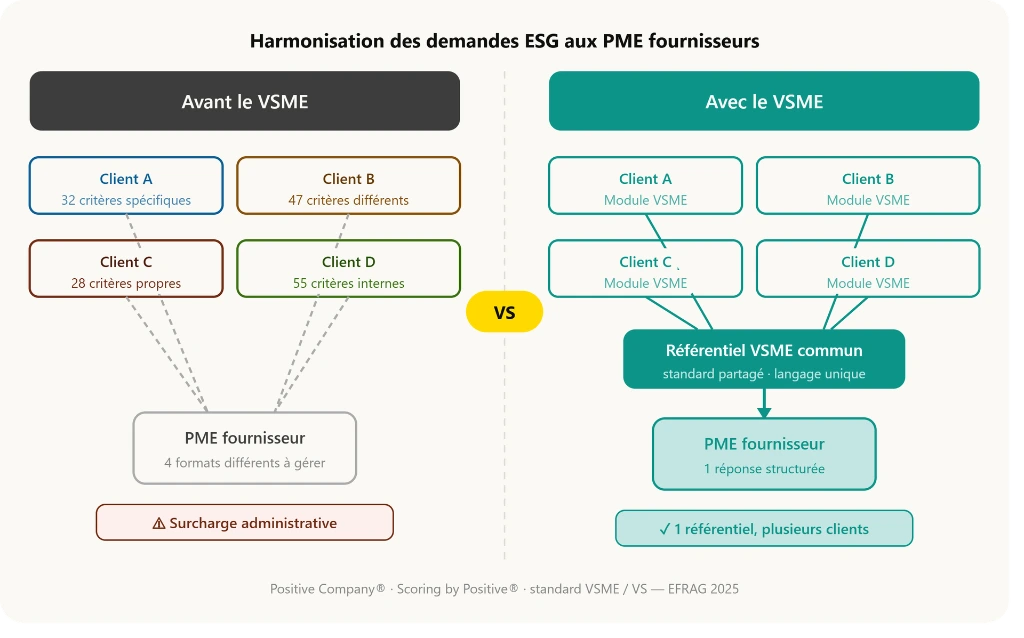
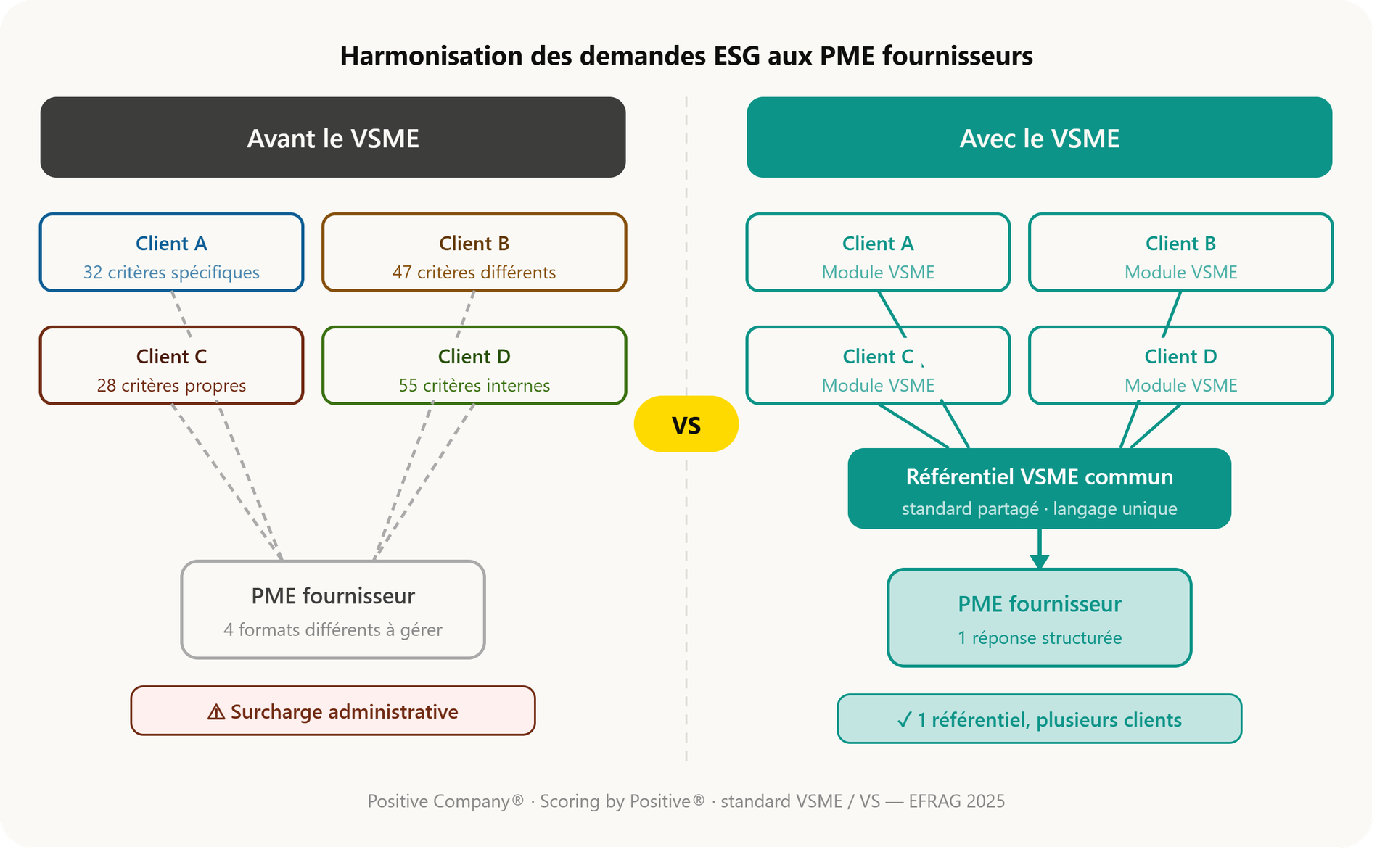
The VSME's aim is not to turn SMEs into CSRD-covered companies, but to give them a common language to answer several customers' requests without rebuilding their information each time. For a long time, compliance meant asking for more data; the VSME takes the opposite approach: improving the quality of exchanges by reducing the variety of requests.
Standardization becomes a competitive tool. An SME able to produce reliable, structured and documented ESG information meets several buyers' expectations at once, and stands out from competitors that are not yet organized.
What the VSME covers in practice: two modules
- Basic module (11 disclosures): the common core. General information (B1), CSR policies and practices (B2), energy and greenhouse gas emissions scopes 1 and 2 (B3), pollution (B4), biodiversity (B5), water (B6), waste and circular economy (B7), workforce characteristics (B8), health and safety (B9), pay and training (B10), anti-corruption (B11).
- Comprehensive module (9 additional disclosures): for SMEs that must meet more detailed expectations from investors, large customers or banks. Strategy and business model (C1), detailed policies (C2), emission reduction targets and transition plan (C3), climate risks (C4), additional workforce data (C5), human rights (C6 and C7), governance (C8 and C9).
Recent changes: to align with the revised ESRS, the standard was simplified. Carbon intensity (B3) and sealed land area (B5) were removed, and staff turnover moved from the basic module (B8) to the comprehensive module (C5). For companies with 10 employees or fewer, some information, notably environmental, is optional.
VSME vs CSRD: what are the differences?
| VSME / VS | CSRD | |
|---|---|---|
| Nature | Voluntary standard | Regulatory obligation |
| Target | SMEs not subject to the CSRD | More than 1,000 employees and more than €450M turnover |
| Double materiality | Not required | Required (see double materiality) |
| Content | Basic module + comprehensive module | Simplified ESRS standards |
| Application | FY 2027 (early application possible from 2026) | Wave 1 since 2024, other companies FY 2027, non-EU groups FY 2028 |
What the Omnibus package changed
The right to refuse beyond the VSME: the 'value chain cap'
This is the most concrete provision for supplier SMEs. Since Directive (EU) 2026/470 (Omnibus I) entered into force on March 18, 2026, a company with 1,000 employees or fewer, in the value chain of a CSRD-covered company, has the right to refuse to provide information beyond the voluntary standard (Article 19a(3) of the amended Accounting Directive). The reporting company may rely on its statement. See our focus on the value chain cap.
- A protective ceiling for SMEs: they can refuse questionnaires that go beyond the VSME.
- A benchmark for buyers: they know what they can reasonably ask for.
A market already adopting the VSME
According to EFRAG, 67% of the banks and large companies surveyed already use the VSME as a reference framework to collect information from their suppliers and partners, and 43% of the companies preparing a report already apply it fully, to answer their customers and secure access to finance.
What this means for your supplier assessment
For buyers, this rule means structuring supplier data collection around a clear, proportionate and shared framework: a supplier evaluation tool aligned with the VSME, calibrated for SMEs and deployable at scale without overloading procurement teams or suppliers. For the data to request first, see CSRD and the value chain.
The real scarce resource: suppliers' capacity to produce information
Debates on ESG regulations often focus on the volume of information requested. They hide a more fundamental reality: for an SME, producing an environmental or social data point takes time, skills, sometimes investment, and often several functions of the company. Each new questionnaire is a real cost.
When several customers ask for similar information in different formats, this cost rises without creating value. The scarce resource is no longer the data, but suppliers' capacity to produce it reliably. This is why recent EU work seeks to harmonize requests to SMEs rather than multiply them.
The real obstacle: over-collection and the lack of a common language
The over-collection paradox
For years, each large group built its own supplier questionnaire, with its own indicators and terminology. The same supplier then has to answer dozens of customers, in different formats, for very similar information. As a result, it spends more time rephrasing information than improving its practices.
Suppliers confirm it. According to the 3rd Responsible Purchasing Barometer by ORSE, Bpifrance and PwC France and Maghreb (2025):
- 66% of suppliers are asked 'often' or 'sometimes' by their customers about ESG topics;
- 41% are asked as early as the tender stage, but receive little support afterwards;
- only 8% are asked about their own subcontractors, beyond tier 1;
- 59% see a gap between their customers' stated CSR ambitions and their commercial practices.
The study encourages procurement teams to move from transferring risk to suppliers ('risk cascading') to sharing it ('risk sharing').
What accounting has already solved
It seems natural for an investor to compare the accounts of two companies from different sectors and countries. This comparability is the result of long work on accounting standards. ESG data is following the same path: the ESRS standardize large companies' reporting, the VSME adapts this logic to SMEs, and the value chain cap sets what a buyer can obtain.
Data produced once, used many times
Yesterday, a sustainability data point was produced to meet a specific obligation, then rarely reused. Today, a supplier's greenhouse gas emissions can feed its customer's scope 3, double materiality assessment, decarbonization plans and climate risk assessment at the same time. The question is no longer 'what information should we ask for?', but 'what information should be shared once so that it serves several players?'. This is what a common standard like the VSME makes possible, with shared ESG indicators.
Towards cooperation between buyers and suppliers
Supporting rather than observing
This shift transforms the purpose of supplier assessment. For a long time, it was mainly about measuring compliance or comparing performance. This remains useful, but is no longer enough: the most advanced companies seek to develop their supply chain's maturity rather than just observe it. In practice: supporting suppliers in structuring their data, sharing common frameworks, limiting redundant requests and focusing on information that is useful for decisions.
A new definition of sustainable performance
A company's sustainable performance increasingly depends on its ecosystem's ability to progress collectively. A high-performing company is also one that builds a value chain where suppliers understand expectations, share a common framework and produce reliable information without a disproportionate administrative burden. This requires the customer to act as facilitator, educator and consistent demander, starting with its strategic suppliers.
How should supplier SMEs prepare?
Even though the VSME is voluntary, SMEs that supply large CSRD-covered companies will be asked for data. Three actions to prepare:
- Identify customers subject to the CSRD: they are the ones who will generate ESG data requests.
- Run a self-assessment on the VSME basic module, to identify available data and priorities.
- Structure your CSR documentation: certifications, internal policies, social and environmental data, to answer with evidence rather than statements.
What this changes for buyers
- A common framework, already used by 67% of the large companies and banks surveyed by EFRAG;
- Comparable data, structured around the same dimensions;
- A defensible approach: relying on the VSME shows a proportionate approach in line with EU texts;
- Easier supplier engagement: a calibrated, free questionnaire gets a higher response rate.
Want to structure the ESG assessment of your SME suppliers?
Scoring by Positive® offers a standard calibrated for SMEs, aligned with VSME requirements, at no cost to your suppliers. It maps your suppliers across 4 dimensions (environment, social, ethics, purchasing) and tracks their progress.
Discover Scoring by Positive® Learn moreConclusion
The VSME marks a step towards maturity in supplier data management. Adopted by the Commission on July 3, 2026 as the 'VS', it is becoming the common language of ESG reporting between large companies and SMEs. For buyers, it is a chance to build their supplier assessment on solid and defensible foundations. For SMEs, it is a protective framework that lets them engage without being overloaded.
FAQ: VSME (VS) and SMEs
The VSME, renamed 'VS', is the voluntary ESG reporting standard developed by EFRAG for SMEs not subject to the CSRD. It lets them answer customer requests with a common framework.
No, it is a voluntary standard. But a company with 1,000 employees or fewer can refuse to give a CSRD-covered customer more information than this standard.
Delegated Regulation (EU) 2026/1560, published on September 21, 2026, applies from financial year 2027, with early application possible from 2026.
It raised the CSRD thresholds (more than 1,000 employees and €450M) and created the value chain cap: suppliers with 1,000 employees or fewer can refuse requests that go beyond the VSME.
Because each large customer long used its own questionnaire: the same supplier answers dozens of similar requests in different formats, at the expense of improving its practices.
Its standard is calibrated for SMEs and aligned with VSME requirements, and the assessment is free for suppliers.
🔗Sources:
- EFRAG. VSME: Voluntary Sustainability Reporting Standard for non-listed SMEs. December 2024.
- Delegated Regulation (EU) 2026/1560 (voluntary standard VS). OJEU, September 21, 2026.
- Directive (EU) 2026/470 (Omnibus I). OJEU, February 26, 2026.
- EFRAG. First Insights into the VSME Market Acceptance. December 2025.
- ORSE, Bpifrance, PwC France and Maghreb. 3rd Responsible Purchasing Barometer. 2025.
- WeCount. VSME / VS: everything about the voluntary standard for SMEs and mid-caps in 2026. August 2026.