
Reading time : 7 min
Written by Gwladys Lecomte
Face à la multiplication des labels RSE disponibles — LUCIE, B Corp, Engagé RSE, Positive Company®... — choisir le bon n'est pas évident. Ce guide vous aide à comprendre les différences réelles entre les labels, à distinguer ce qui n'en est pas (comme EcoVadis), et à identifier le label adapté à votre situation, votre taille et vos objectifs.
In this article, you will discover :
- What differentiates an CSR label, a certification, a standard, and a charter
- Detailed descriptions and comparison of the 4 main generalist CSR labels (B Corp, LUCIE 26000, Engagé RSE, Positive Company®)
- Pourquoi EcoVadis n'est pas un label RSE — et ce que c'est vraiment
- Sectoral and thematic labels to know
- The concrete criteria for choosing your label well
- How much does a CSR label cost?
- Why some companies choose Positive Company®
What is a CSR label?
A CSR label is an official recognition certifying that an organization structures its approach to social responsibility (social, environmental, governance) according to a specific framework, generally through an audit and sometimes a consultation with its stakeholders. It is issued by an independent third-party organization and represented by a logo or badge to display.
The CSR label is part of a continuous improvement logic: most require regular renewal audits. A certified company can lose its label if it is not diligent in its commitments.
The ISO 26000 standard, adopted in 2010, is the international reference on which most CSR labels rely. It covers 7 themes: governance, human rights, labor relations and conditions, environment, fair operating practices, consumer issues, and communities and local development.Important: ISO 26000 is not certifiable. It serves as a basic reference, but does not directly lead to a label.
Label, certification, standard, charter: what are the differences?
These terms are often confused, including in online content. Here are the distinctions to know before choosing.
The CSR label
Outil indépendant obtenu lorsque l'entreprise prouve qu'elle respecte les critères d'un référentiel défini par un organisme tiers. Il peut être apposé sur les communications. Attention : certaines entreprises créent leur propre label — c'est une pratique de greenwashing.
The CSR certification
Framed by law but not mandatory. It attests to compliance with a recognized standard (ISO 9001, ISO 14001…). It is the most rigorous framework as it indicates a commitment beyond mere legal requirements.
The CSR standard
Defines a framework with recommendations and best practices. ISO 26000 is the main example: it provides direction but does not lead to formal certification.
The CSR charter
Formalizes a company's commitments in the form of a declaration, without verification by a third party. Examples: Diversity Charter, Responsible Supplier and Purchasing Relations Charter. Useful for communication, but without probative value.
Why get CSR certified?
Obtaining a CSR label offers several concrete advantages for an organization:
Credibilize its approach and avoid greenwashing
A label issued by an independent organization based on specific criteria guarantees that commitments are verified, not self-declared. At a time when the EmpCo directive (EU 2024/825) prohibits generic environmental claims without justification since September 27, 2026, an audited label provides real protection.
Differentiate in tenders
More and more private and public tenders are incorporating CSR criteria in the selection of providers. A recognized label allows for compliance with these requirements with documented evidence.
Strengthen the employer brand
83% of employees report enjoying working more in a company that implements a CSR strategy (MEDEF, 2020). The involvement of employees in the labeling process generates a sense of pride and belonging.
Anticipate regulatory requirements
La CSRD impose progressivement des obligations de reporting durabilité à des milliers d'entreprises européennes. Un label RSE structuré facilite la collecte des données nécessaires et montre une démarche de fond — pas seulement du reporting.
Reduce risks and improve performance
Security, energy savings, process improvement: the actions required to obtain an CSR label directly contribute to operational performance and risk reduction.
The 4 main generalist CSR labels
B Corp
Founded in 2006 by B Lab, an American NGO, B Corp is the most internationally recognised label. As of March 2025, there are 9,576 B Corp certified companies in 102 countries and 160 sectors. In France, around 200 companies are B Corp certified.
Process: online self-assessment via the B Impact Assessment (BIA), verification by B Lab, signing of the Declaration of Interdependence, amendment of legal statutes to incorporate the social purpose.
Criteria: minimum score of 80/200 on the BIA, covering 5 pillars: employees, governance, environment, community, clients.
Renewal: every 3 years.
Strengths: international recognition, active community, high standards.
Limits: lengthy and costly process, mandatory modification of statutes, less suitable for very small structures.
(Source: bcorporation.net, March 2025)
LUCIE 26000
First French CSR label, created in 2007 by the LUCIE Agency in partnership with AFNOR Certification and Vigeo Eiris. It is based on the 7 pillars of ISO 26000 and offers a framework tailored to the organisation's activity (SMEs, local authorities, banks, training organisations).
Processus : self-assessment, audit by a partner organization (Bureau Veritas Certification, Baker Tilly, RSEVAL or CertUp Maïeutika), interviews with stakeholders, score out of 1000 (threshold: 500/1000), engagement plan validated by an independent committee.
Renewal : every 4 years, with a follow-up evaluation at 2 years.
Strengths : history, large community, rigorous and tailored framework according to the type of organization.
⚠️ Nombre exact d'entreprises labellisées : à vérifier directement auprès de l'Agence LUCIE — les données publiques disponibles varient selon les sources.
Engagé RSE (AFNOR)
Created in 2017 by AFNOR Certification, the French standardization authority. The Engaged CSR label has been adopted by over 600 companies in France by the end of 2023. It is recognized internationally through the Responsibility Europe network.
Process : on-site evaluation by an independent expert, interviews with 5 stakeholders, performance report with improvement suggestions, awarding of one of the 3 levels.
3 levels : Progression / Confirmed / Exemplary.
Framework : ISO 26000, audited on 55 criteria, aligned with the 17 SDGs.
Renewal : 3 years.
Strengths : institutional authority of AFNOR, progression by levels, international recognition.
(Source: AFNOR CSR Report 2023)
CSR Label Positive Company®
Created in 2019, the Positive Company® Label is a French CSR label structured around ISO 26000 and European standards. It includes over 200 certified companies in France, Europe, and Africa.
Process : documented evaluation questionnaire (over 200 questions), consultation of stakeholders (employees, clients, suppliers), evaluation and validation by a committee.
3 levels : 1, 2 or 3 stars.
Duration : generally 2 to 3 months.
Strengths : systematic consultation of stakeholders (not just a document audit), fast process, financially accessible including for small organizations, aligned to anticipate CSRD and VSME requirements, human support by dedicated consultants.
Différenciateur : le référentiel est conçu pour anticiper les exigences CSRD — ce que peu de labels intègrent explicitement.
EcoVadis: a CSR label or a rating?
EcoVadis is regularly mentioned in comparisons of CSR labels, it is a confusion to correct.
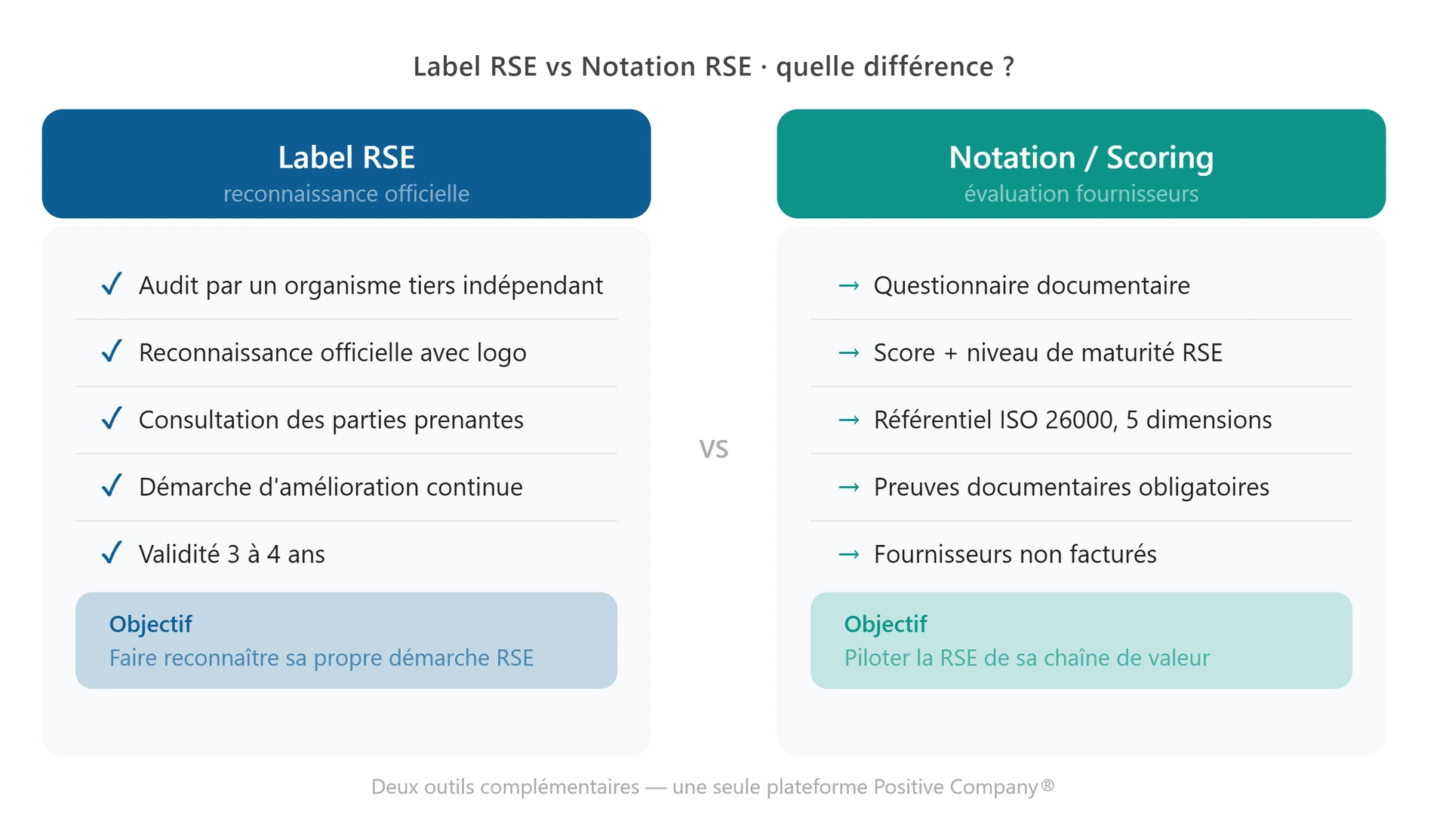
EcoVadis is not a label: it is a CSR rating platform, mainly used by large buyers to assess the CSR performance of their suppliers.
Founded in 2007, EcoVadis evaluates companies on 21 criteria divided into 4 themes (environment, social and human rights, ethics, responsible purchasing), resulting in a score out of 100, valid for 12 months. Depending on the score, the company receives a medal: Bronze (top 35 %), Silver (top 15 %), Gold (top 5 %) or Platinum (top 1 %), provided that none of the 4 thematic scores is below 30/100..
The difference is structural :
- A CSR label is obtained at the end of a labeling process (audit, sometimes consultation of stakeholders) and results in a recognition materialized by a logo to display
- EcoVadis provides a score at a given moment, which reflects the measured performance but does not constitute a label in the strict sense
Cette distinction compte particulièrement si votre enjeu est d'évaluer la performance RSE de vos propres fournisseurs, plutôt que de faire reconnaître votre propre démarche. C'est le rôle que joue Scoring by Positive® : une plateforme d'évaluation fournisseurs pensée sur le même principe qu'EcoVadis, avec un accompagnement humain, des données hébergées en France, et, différenciateur clé, sans facturer la démarche aux fournisseurs évalués.
Sectoral CSR labels
Some labels adapt to the specificities of a sector, making the labeling more relevant and the framework better calibrated:
- Label Vignerons Engagés — viticulture
- Label Événement Éco-Engagé — événementiel
- Label Fair Play For Planet — sport
- Label Commerçant Responsable — commerce de proximité
- Label PME+ — entreprises indépendantes françaises fournissant des produits à la distribution (alimentaire et non alimentaire), attribué par Ecocert, fondé par la FEEF
Thematic CSR labels
These labels target a specific CSR issue, in addition to a general approach:
- Label Diversité — égalité des chances dans le recrutement
- Label Égalité professionnelle (AFNOR) — égalité femmes-hommes
- Label Relations fournisseurs et achats responsables — pratiques achats éthiques
- Label Numérique Responsable — réduction de l'impact du numérique
- BiodiverCity — biodiversité dans le bâtiment
How much does a CSR label cost?
C'est la question la plus posée — et la plus difficile à répondre de façon générique. Les coûts varient selon :
- The size of the organization (the scales are generally indexed to revenue or workforce)
- The level of support included (self-service or dedicated consultants)
- The scope of the audit (documentary only, or with stakeholder consultation)
- Internal costs: time spent by teams to collect documents, respond to questionnaires, prepare interviews
Ce qu'il faut faire avant de choisir : demander un devis détaillé à chaque organisme, intégrer le coût total (audit + accompagnement + temps interne) dans votre comparaison, et ne pas vous fier à des fourchettes génériques trouvées en ligne — elles ne tiennent pas compte de votre situation spécifique.
How to choose your CSR label well?
The "best" CSR label does not exist in absolute terms. Here are the 6 criteria to evaluate:
Your CSR maturity level
If you are starting out, a label that supports progression through levels (Engaged CSR, Positive Company®) will be more suitable than a binary label. If you already have an advanced approach, B Corp or LUCIE can enhance this level of requirement.
2. Your priority issues
Some frameworks give more weight to the environment, others to governance or social issues. Identify your priority issues before choosing.
The size and sector of your company
Some labels are more suited for large organizations (detailed frameworks, advanced reporting), while others are accessible to small businesses from the start. Sector-specific labels may be more relevant depending on your activity.
The time available internally
Find out about the number of man-days required before committing. A process of 2-3 months like Positive Company® does not require the same internal mobilization as a B Corp process of 12 to 18 months.
5. Your budget
Always request a detailed quote. Include internal costs (team time) and not just audit fees.
The expectations of your stakeholders
If your clients, partners, or calls for tenders explicitly mention a particular label, this will guide your choice. If your goal is more to evaluate your suppliers, you need a scoring solution (Scoring by Positive®, EcoVadis), not a label.
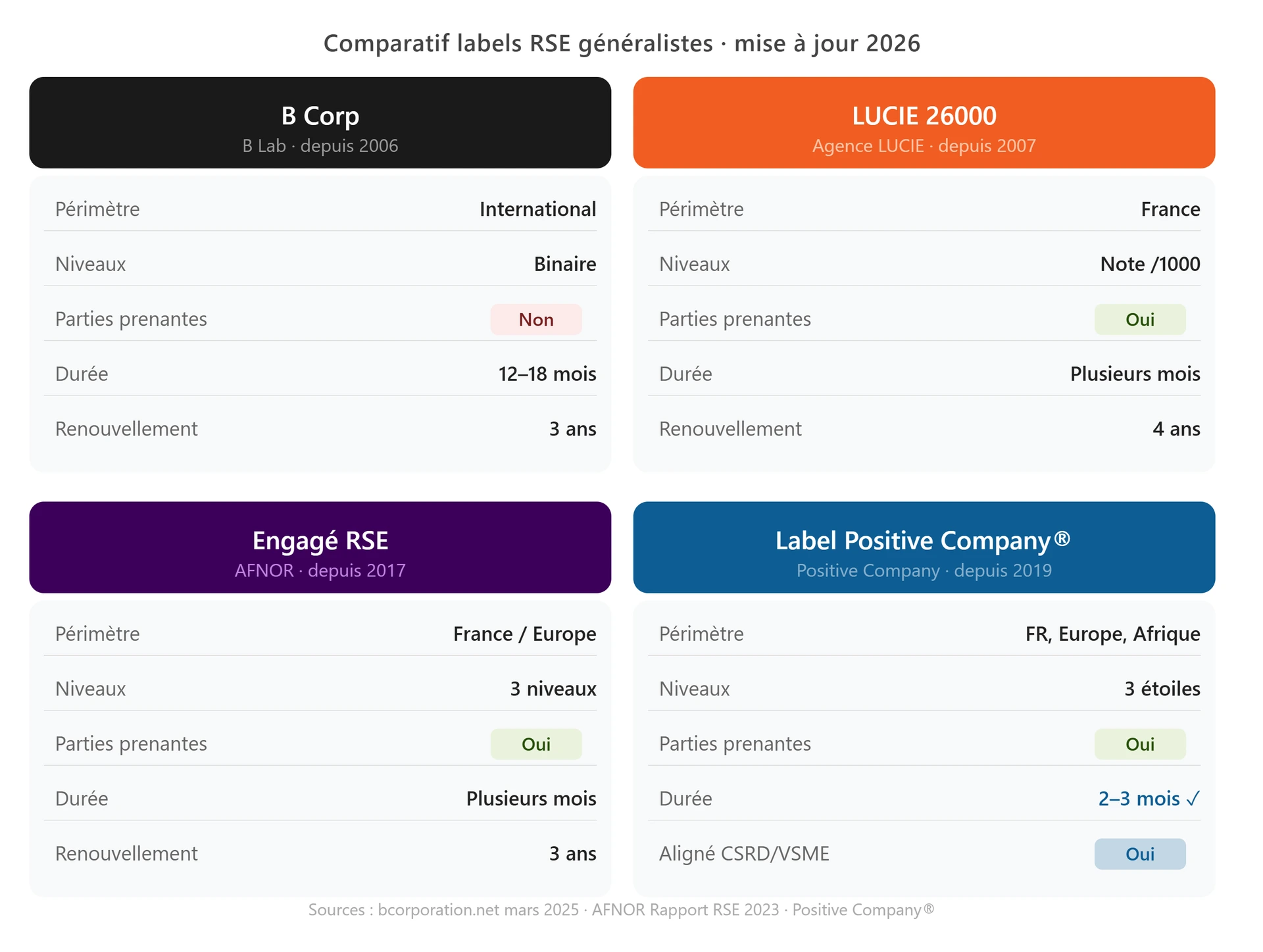
Comparative table of CSR labels 2026
B Corp | LUCIE 26000 | Engagé RSE (AFNOR) | Label Positive Company® | |
Issuing organization | B Lab (American NGO) | LUCIE Agency (with AFNOR Certification and Vigeo Eiris) | AFNOR Certification | Positive Company |
Created in | 2006 | 2007 | 2017 | 2019 |
Scope | International (102 countries) | France (1st French CSR Label) | France / Europe (Responsibility Europe) | France, Europe, Africa |
Reference framework | B Impact Assessment | ISO 26000 | ISO 26000, 55 criteria | ISO 26000, European standards, SDGs |
Levels | Binary | Binary (score /1000) | 3 levels: Progression / Confirmed / Exemplary | 3 stars |
Stakeholder consultation | No (questionnaire) | Yes (interviews) | Yes (5 stakeholders) | Yes (employees, clients, suppliers) |
Process duration | 12-18 months | Several months | Several months | 2-3 months |
Renewal | 3 years | 4 years (follow-up at 2 years) | 3 years | To be specified |
Certified companies | ~9,576 worldwide / ~200 France (March 2025) | To be verified with LUCIE | +600 in France (end of 2023) | +250 in France, Europe, Africa |
Modification of statutes | Mandatory | No | No | No |
(Sources: bcorporation.net March 2025; AFNOR CSR Report 2023; Positive Company® data)
Transparency note: some figures (exact number of certified companies for B Corp and CSR Committed, precise validity duration of each label) vary according to the sources consulted and evolve regularly. We invite you to verify this information directly with each organization before committing.
What concretely differentiates these labels beyond the table
- B Corp est le plus internationalement reconnu, avec un processus exigeant et un renouvellement tous les 3 ans.
- LUCIE 26000 is historically the first French CSR label (2007), with a rigorous framework tailored to the type of organization.
- Engagé RSE bénéficie de l'autorité institutionnelle de l'AFNOR et propose un parcours en plusieurs niveaux (progression, confirmé, exemplaire).
- Positive Company® stands out for its systematic consultation of stakeholders (not just a documentary audit), a quick process (2 to 3 months), a financially accessible positioning including for the smallest structures, and a framework aligned to anticipate CSRD and VSME requirements.
Why some companies choose Positive Company®
Without claiming to be THE best label for all situations, Positive Company® stands out through several structuring choices:
- A real consultation of stakeholders (clients, employees, suppliers) in addition to the documentary audit
- A quick process : 2 to 3 months in general
- A framework aligned with European standards, designed to anticipate the requirements of the CSRD and the VSME
- A active community of over 200 companies certified in France, Europe, and Africa
- A human support from dedicated consultants, rather than a self-service tool
- Financially accessible, including for the smallest structures
Une question ?
A CSR label is an official recognition certifying that an organization structures its approach to social responsibility according to a specific framework, through an audit and sometimes a consultation of stakeholders. It is issued by an independent third-party organization and materialized by a logo to display. It should not be confused with ISO 26000 (non-certifiable guidance standard) or with rating systems like EcoVadis.
A certification formally attests that an organization meets the requirements of a specific standard (ISO 9001, ISO 14001…). A CSR label is a recognition granted based on a framework specific to the issuing organization. One says "labelled Positive Company®", never "certified CSR Positive Company®".
No. CSR labels are voluntary approaches. The CSRD, on the other hand, imposes sustainability reporting obligations on certain European companies — it is not a label, but a regulatory obligation. A CSR label can, however, facilitate the collection of data necessary for CSRD reporting.
Yes, nothing prohibits it. Some companies combine B Corp and a national label like Engagé RSE or Positive Company® Label. The question is whether each label addresses a distinct issue or if the approach is redundant.
No. EcoVadis is a CSR rating platform, mainly used by buyers to evaluate their suppliers. It provides a score out of 100 and a medal (Bronze, Silver, Gold, Platinum) valid for 12 months — not a label in the strict sense. If your goal is to evaluate your suppliers rather than to have your own approach recognized, you need a scoring solution.
This varies significantly depending on the label: from 2-3 months for Positive Company® to 12-18 months for B Corp. The duration also depends on your existing CSR maturity level and the internal resources you can mobilize.