
Sustainable vs. Responsible Purchasing: What are the differences?
Reading time: 6 minutes
Ecrit par Manoëlle Dousson
In a context of cost pressure, regulatory pressure (duty of vigilance, CSRD), and increasing customer expectations, the purchasing function becomes astrategic lever for transformation.
However, two concepts are often confused:sustainable purchasing and responsible purchasing. They overlap, but do not exactly cover the same operational reality. Understanding their difference allows for aligning purchasing policy, CSR objectives, and performance indicators to create value... sustainablyANDresponsibly.
What to remember
Deux définitions indispensables
Sustainable Purchasing
Les achats durables visent à minimiser les impacts environnementaux des biens et services sur tout leur cycle de vie. Ils mobilisent des critères tels que l’empreinte carbone (notamment Scope 3), la consommation de ressources, la recyclabilité, la réparabilité, la sobriété énergétique et la circularité.
In short: the main angle is environmental and long-term (sustainability of the product, resource, and supply model).
Responsible Purchasing
Responsible purchasing covers abroader vision, integrating environment, social, and governance. It includes, among other things, respect for human rights in the supply chain, health and safety, business ethics, compliance, inclusion, local anchoring, and transparency.
In short:the angle is global and 360° (Environment, Social, Governance), with a strong demand for responsibility towards stakeholders.
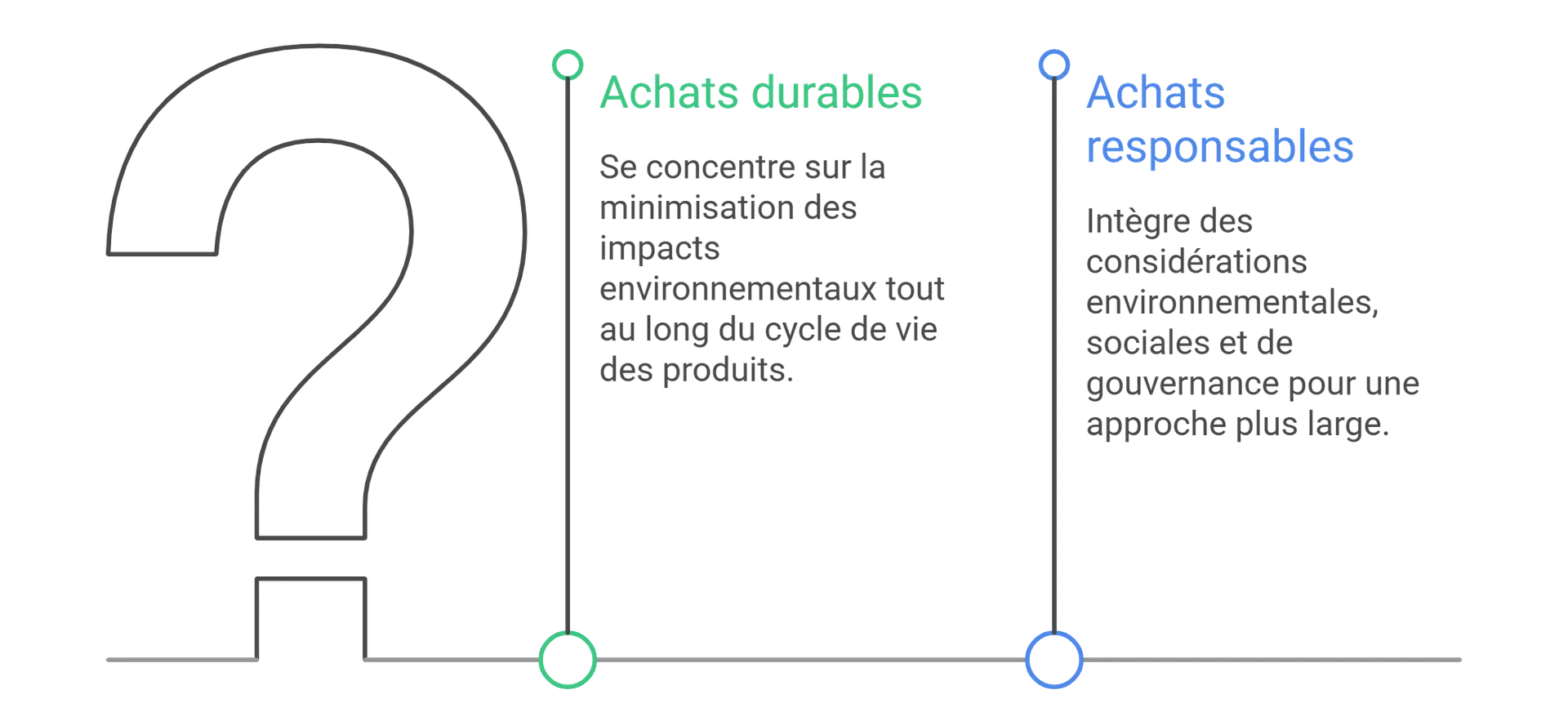
Les différences, point par point
Sustainable Purchasing | Responsible Purchasing | |
Purpose | Reduce environmental footprint and promote circularity | Ensure "fair" purchasing across all ESG dimensions |
Scope | Product/service and life cycle | Supply chain, suppliers, territories, stakeholders |
Key levers | Eco-design, LCA, materials, energy, logistics | Droits humains, éthique, inclusion, compliance, gouvernance fournisseurs |
Indicators | CO₂eq/€ spent, % recycled/renewable materials, repairability rate | Social audits, % inclusive purchases, ethical scoring, vigilance clauses |
Governance | Management by environmental performance | Management by risks and compliance + social and societal impacts |
Timeframe | Long term (resource resilience) | Court + long termes (risques de conformité et réputation immédiats, transformation structurelle, résilience) |
To remember: sustainable purchasing is a building block of responsible purchasing. A coherent "responsible" policy incorporates environmental sustainability but is not limited to it.
3. Implications for the company
3.1 Stratégie & alignement
Sustainable purchasing: contribution toclimate, energy, circularity, eco-design goals.
Responsible purchasing: contribution tooverall ESG goals, due diligence, compliance, and reputation.
3.2 Risk management
Sustainable : material dependency, volatilityenergy,environmental regulations.environnementales.
Responsible : social and ethical risks, disruptions related tonon-compliance, riskslegal and reputational.
3.3 Value Creation
Sustainable : energy efficiency, repairability, optimized logistics.
Responsible : access to markets(tenders requiring ESG criteria),customer loyalty,employer brand, access to, accès à la sustainable finance.
4. Concrete examples by purchase category
4.1 IT Equipment
Sustainable: select laptops rated for repairability, extend usage duration, prioritize refurbished.
Responsible: clauses on responsible minerals, subcontractor audits, no child labor clauses, end-of-life take-back and traceability.
4.2 Textiles
Sustainable: recycled materials, less polluting treatments, comparative life cycle analyses.
Responsible: respect for freedom of association and decent wages for contractors, social certifications, life cycle analysis.
4.3 Transport and Logistics
Sustainable: decarbonization plan (low-emission fleet, massification, rail), reusable packaging.
Responsible: driver safety, rest time, subcontracting compliance, local purchases when relevant.
4.4 Energy
Durables : contrats d’énergie bas-carbone, efficacité énergétique.
Responsables : clauses sociales d’insertion, contrôle de la sous-traitance et de la santé-sécurité.
Evaluate your suppliers on their responsible purchasing
Avec notre outil Scoring by Positive® vous pouvez évaluer vos fournisseurs sur leur RSE et ainsi déterminer si vos achats sont durables et responsables.
Yes, but set a 360° trajectory from the start and map out major social risks.
Par des pilotes chiffrés (TCO), une gestion des risques claire, et des success stories fournisseurs.
By using internal or external assessments (for example, the Scoring by Positive® tool).
Both. Scoring evaluates your suppliers on environmental criteria, as well as social and governance criteria.
Questions fréquentes
Some frequently asked questions about sustainable and responsible purchasing.