
Temps de lecture : 9 minutes
Written by Matthieu Bruneau De La Salle
In summary:
- The SPASER (Scheme for the Promotion of Socially and Environmentally Responsible Public Procurement) is mandatory for public buyers whose purchases exceed €50 million excluding tax per year
- Il fixe des objectifs sociaux et environnementaux, des indicateurs de suivi et des modalités de pilotage — publiés tous les deux ans
- As of August 21, 2026, new obligations strengthen the integration of environmental criteria in public contracts
- The CSR evaluation of suppliers is one of the key tools to make a SPASER operational and measurable
Public actors are increasingly expected to demonstrate their ability to integrate social, environmental, and economic criteria into their purchases. The SPASER has become, in just a few years, the central tool for this transformation. Here’s what you need to know to understand its stakes, obligations, and concrete implementation in 2026.
What is the SPASER?
The SPASER (Scheme for the Promotion of Socially and Environmentally Responsible Public Procurement) is a strategic document that allows public buyers to structure their responsible purchasing policy: objectives, actions, monitoring indicators, and management methods.
It also makes this policy more understandable for suppliers, elected officials, citizens, and stakeholders, by translating general commitments into concrete and measurable actions.
The SPASER, a requirement for certain public buyers
The SPASER is provided for in the article L.2111-3 of the Public Procurement Code. It concerns buyers subject to the Public Procurement Code whose total annual purchases exceed a threshold set by regulatory means.
Ce seuil est aujourd'hui fixé à 50 millions d'euros hors taxes par l'article D.2111-3 du même code — abaissé de 100 M€ à 50 M€ par le décret du 2 mai 2022, entré en vigueur au 1er janvier 2023.
Those concerned, when they exceed this threshold:
- The State and its ministries
- The large local authorities: regions, departments, metropolises
- Certain public institutions
- Purchasing centers
- Large public operators
The framework sets social and ecological objectives, outlines their implementation and monitoring methods, and relies on published indicators every two years.
From social to environmental: how the SPASER has evolved
The SPASER did not appear immediately in its current form. It was built gradually, at the intersection of several legislative developments.
Created by the law of July 31, 2014 related to social and solidarity economy, it initially targeted socially responsible public procurement, with particular attention to the integration and access of certain groups to public contracts.
In 2015, the law related to energy transition for green growth adds the ecological dimension. The framework becomes a tool for promoting public procurement that is both socially and ecologically responsible.
Its codification in the Public Procurement Code in 2019, followed by developments from the Climate and Resilience law, the decree of May 2, 2022, and the Green Industry law have gradually strengthened its role.
A new step on August 21, 2026
Starting from August 21, 2026, certain provisions from the Climate and Resilience law will apply to public contracts and concessions for which a consultation is initiated from that date.
In concrete terms :
- When they use a plurality of criteria, at least one of them must take into account the environmental characteristics of the offer
- When the buyer uses a single criterion, it must be the cost, which may be based on the life cycle cost, and taking into account the environmental characteristics of the offer
This deadline does not directly change the SPASER obligation, but it reinforces its usefulness: responsible purchasing strategies must be more concretely translated into consultations and the execution of contracts.
The four levers of SPASER to structure responsible public procurement
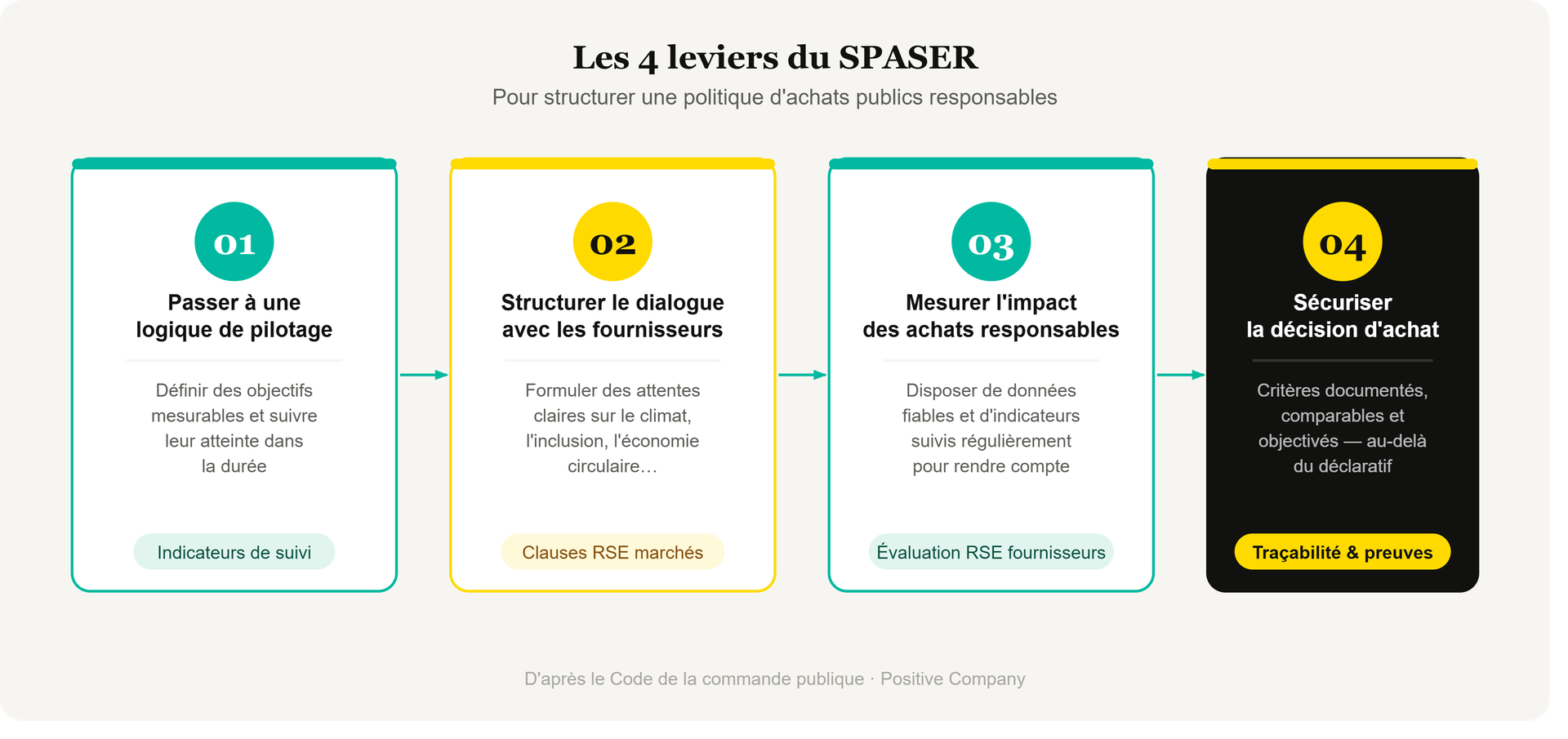
SPASER links regulatory requirements to their operational translation. It allows public buyers to structure their approach around four levers.
1. Move from a compliance logic to a management logic
It requires the public buyer to define social and environmental objectives, and then to monitor their achievement over time. A SPASER can rely on several families of indicators:
- Share of contracts integrating an environmental consideration
- Share of contracts integrating a social consideration
- Share of contracts awarded to social and solidarity economy structures
- Number of integration hours generated by public contracts
- Share of contracts integrating a criterion related to the life cycle cost
- Rate of suppliers evaluated on social, environmental, or ethical criteria
- Rate of suppliers who have provided documented CSR justifications
These indicators allow for a transition from a general intention to measurable monitoring of the responsible purchasing policy.
2. Structure the dialogue with suppliers
Buyers must be able to articulate clear expectations on their priority topics: climate, circular economy, inclusion, professional integration, professional equality, accessibility, digital sobriety, or managing environmental impacts.
3. Measure the actual impact of responsible purchasing
The SPASER is not limited to displaying commitments: it requires reliable data, regularly monitored indicators, and the ability to report on progress made.
4. Secure the purchasing decision
Social and environmental criteria must be documented, comparable, and objective, in order to avoid purely declarative or difficult-to-verify approaches.
The benefits of a SPASER approach
Beyond the regulatory obligation, the SPASER offers several concrete benefits.
It first allows for mobilizing internal teams around a common framework. Purchasing departments, business prescribers, elected officials, sustainable development departments, or legal services can rely on a shared roadmap.
The SPASER can also help to identify risks and opportunities related to purchases: dependence on certain suppliers, exposure to social or environmental risks, lack of appropriate clauses, insufficient documentation follow-up, or on the contrary, potential for responsible innovation.
Finally, it strengthens the transparency and credibility of the public buyer. By publishing its objectives and indicators, the organization accounts for its contribution to ecological transition, social inclusion, and the development of a more responsible economy.
Some examples of public SPASERs
Plusieurs organismes publics ont déjà publié leur SPASER — voici quelques références pour s'en inspirer :
| Organization | SPASER | Content |
|---|---|---|
| The State | SPASER 2025-2027 (published on December 10, 2025) | Interministerial, €24.8 billion in purchases, 3 axes and 13 objectives |
| Dijon Metropolis | SPASER 2024-2027 | Example of a local authority with objectives and indicators |
| Bank of France | SPASER 2024-2026 | Public establishment, social, environmental, and ethical axes |
| Resah | SPASER 2023-2027 | Purchasing center dedicated to public health actors |
| UGAP | SPASER 2025-2027 | Public purchasing center — third SPASER published |
These examples show that the SPASER is not just a legal document. It is also a management tool, a dialogue tool, and a means of gradually transforming purchasing practices.
What tools to make a SPASER operational?
To produce effects, a SPASER must rely on reliable data and appropriate monitoring tools. Public buyers can notably mobilize :
- A mapping of supplier risks
- Social and environmental clauses in contracts
- Regular monitoring indicators
- Structured supplier questionnaires
- Audits and extra-financial reporting
- Some CSR supplier evaluation platforms
💡 Scoring by Positive®: assess the CSR maturity of your suppliers within the framework of a SPASER
Scoring by Positive peut contribuer à objectiver les pratiques RSE de vos fournisseurs ou partenaires, à collecter des preuves documentaires et à disposer d'indicateurs comparables dans le temps — directement utilisables dans le cadre du suivi de votre SPASER.
The CSR evaluation of suppliers is not the core of the SPASER, but it is one of the most effective tools to objectify supplier practices, track progress, and support the management of a responsible purchasing policy.
Comment évaluer ses fournisseurs RSE → Demander une démo Scoring
Key takeaways
The SPASER is both a regulatory obligation and a strategic tool. It marks a strong evolution in public procurement: purchases are no longer only evaluated in terms of price or technical compliance, but also in terms of their social, environmental, and territorial contribution.
For public buyers, the challenge is now to move from a stated ambition to a managed, documented, and measurable approach. Its effectiveness will depend on the quality of the objectives, the relevance of the indicators, the mobilization of purchasing teams, the dialogue with suppliers, and the regular monitoring of results.
Chronological markers
| Date | Text | Main contribution |
|---|---|---|
| July 31, 2014 | ESS Law | Creation of the socially responsible purchasing scheme |
| January 28, 2015 | Decree No. 2015-90 | First threshold of 100 million euros excluding tax |
| August 17, 2015 | Energy transition law | Addition of the ecological dimension |
| April 1, 2019 | Public procurement code | Codification of the SPASER in article L.2111-3 |
| August 22, 2021 | Climate and Resilience Law | Strengthening monitoring and indicators |
| May 2, 2022 | Decree No. 2022-767 | Lowering the threshold from 100 million euros to 50 million euros excluding tax |
| October 23, 2023 | Green Industry Law | Extension of the scope and environmental strengthening |
| August 21, 2026 | Climate and Resilience Law | Generalization of environmental criteria in allocations |
FAQ — SPASER and responsible public procurement
The SPASER is the Scheme for the Promotion of Socially and Ecologically Responsible Public Procurement. It is a mandatory strategic document for public buyers whose purchases exceed 50 million euros excluding tax per year. It sets social and environmental objectives, their implementation methods, and indicators published every two years.
The buyers subject to the Public Procurement Code whose annual purchase amount exceeds €50 million excluding tax are concerned: the State, large local authorities (regions, departments, metropolitan areas), certain public institutions, purchasing centers, and large public operators. This threshold was lowered from €100 million to €50 million by the decree of May 2, 2022.
The responsible purchasing policy is a general approach to integrating CSR criteria into purchases. The SPASER is its mandatory formalization for the concerned buyers: it requires defining measurable objectives, monitoring indicators, and publishing results every two years. It is the transition from intention to obligation of results.
The classic indicators of a SPASER cover: the share of contracts incorporating environmental or social criteria, the share of contracts awarded to social economy structures, the number of integration hours generated, the share of contracts incorporating a life cycle cost criterion, and the rate of suppliers evaluated on documented CSR criteria.
Starting from August 21, 2026, public buyers will have to integrate at least one environmental criterion into their contracts when using multiple award criteria. When a single criterion is used, it must take into account the environmental characteristics of the offer. This obligation reinforces the need to have an operational SPASER with concrete environmental indicators.
The CSR assessment of suppliers allows for the objectification of the practices of its business partners through a structured questionnaire, supplemented by supporting documents. It directly feeds into the indicators of the SPASER (rate of evaluated suppliers, rate of documented justifications) and allows for a shift from a declarative approach to a measurable approach. Solutions like Scoring by Positive enable this assessment to be deployed in a personalized and traceable manner. Learn more →
The SPASER and the duty of vigilance are two distinct but complementary obligations. The SPASER concerns public buyers and focuses on responsible purchasing policy. The duty of vigilance concerns large private companies and focuses on the identification and prevention of CSR risks in the supply chain. Both require documentation and management of supplier practices.
Sources:
- Légifrance, Public Procurement Code, article L.2111-3
- Légifrance, Public Procurement Code, article D.2111-3
- Directorate of Legal Affairs, SPASER Technical Sheet, April 2024
- Légifrance, Decree No. 2022-767 of May 2, 2022
- State Purchasing Directorate, SPASER 2025-2027
- Bank of France, Responsible and Sustainable Purchasing