
Reading time: 10 minutes
Article published in May 2023, updated in August 2026
In this article, you will discover:
- How Egis structured its ESG governance with a global matrix organization and ESG & Climate Directors by entity and region
- Egis' Net Zero targets validated by the SBTi: quantified targets for 2033 and 2050 across scopes 1, 2, and 3
- How Egis engages its employees through the Egis Foundation, skills sponsorship, and individual engagement initiatives
How to turn CSR commitments into a true performance driver? This is the challenge taken on by Egis, an international player in architecture, consulting, construction engineering, and mobility services. Invited by NaTran as part of Scoring by Positive — the CSR performance evaluation tool of Positive Company — the Group has demonstrated a structured sustainable transformation: an ESG governance integrated on a global scale, a climate trajectory validated by the SBTi, and a social commitment supported by its employees.
A structured ESG governance on a global scale
In 2023, Egis strengthened its ESG governance by appointing an ESG & Climate Director in each operational entity and region. Their mission: to translate the Group's ESG commitments as closely as possible to the businesses and projects.
Every month, these stakeholders meet in a "Coreteam" to share progress, resolve friction points, and manage indicators.
Vocabulary point:
- ESG Governance: refers to how a company organizes, manages, and reports on its Environmental, Social, and Governance commitments. A structured ESG governance allows for the integration of these issues into decisions at all levels of the company.
- Matrix organization: a model in which the same mission is implemented both by operational entity and by region, rather than centralized in a single direction. This allows for closer management of local realities.
- Coreteam: a working group that brings together the ESG & Climate Directors from the various entities and regions of the Egis Group each month.
A Net Zero trajectory validated by the SBTi
Certified "Corporate Net-Zero" targets
In 2024, Egis reaches a major milestone: its climate targets are certified "Corporate Net-Zero" by the Science-Based Targets initiative (SBTi), a framework recognized as the global reference for climate alignment.
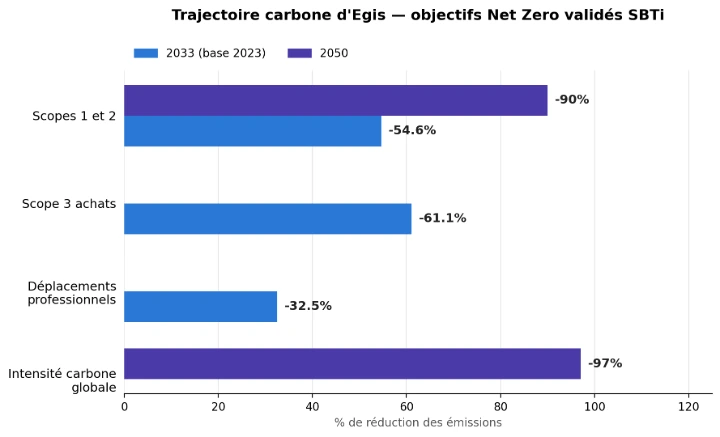
Short-term objectives (2033), based on the year 2023:
- -54.6% of scopes 1 and 2 emissions (in absolute terms)
- -61.1% of scope 3 emissions related to purchases (per M€ of added value)
- -32.5% for business travel
- -61.1% for commuting (per employee)
Long-term objectives (2050):
- -90% of scopes 1, 2, and certain scope 3 emissions
- -97% of the carbon intensity of sold products, purchases, fixed assets, and employee mobility
To achieve Net Zero, Egis commits to neutralizing the remaining residual emissions after reduction.
Vocabulary point:
- Net Zero: a company's commitment to reduce its greenhouse gas emissions as much as possible, then to offset the unavoidable residual emissions. Net Zero differs from "carbon neutrality" by its requirement for actual reduction before any offsetting.
- SBTi (Science-Based Targets initiative): an international organization that validates companies' emission reduction trajectories according to scientific criteria aligned with the Paris Agreement.
- Scopes 1, 2, and 3: the three emission scopes of a company. Scope 1 covers direct emissions, scope 2 covers indirect emissions related to energy consumed, and scope 3 covers all indirect emissions in the value chain (purchases, travel, sold products).
A measured footprint across the entire value chain
In 2024, Egis achieves nearly total coverage of its emissions:
- 67 countries covered
- 98.9% of the revenue taken into account
- All integrated professions: architecture, consulting, engineering, and operations
Social engagement: valuing the talents of the company
ESG transformation cannot be driven solely from the top. It must also emerge from within. Egis has structured several initiatives. As part of the agreement on diversity and quality of life at work, a budget has been dedicated to experimenting with new forms of mobilization.
On the agenda
- Actions led by the Egis Foundation that mobilizes the Group's expertise to support projects of general interest dedicated to combating climate change and a just transition,
- Individual engagement initiatives to give meaning to daily work,
- An HR policy aligned with the issues of diversity, quality of life, and well-being.
The goal is simple: to ensure that everyone, regardless of their profession, can identify with the company's mission.
The Egis Foundation
The Egis Foundation mobilizes the Group's expertise to support projects of general interest dedicated to combating climate change and a just transition, in the fields of environment, solidarity, and education.
Skills sponsorship: first steps in 2024
In 2024, Egis launched a pilot project for skills sponsorship, to structure a useful collective commitment aligned with the company's values. This project revolves around several initiatives:
- Thanks to the winners of the "My Little Planet" challenge, who turn their victory into impactful projects
- Through an open call for projects, to support associations working for climate, education, or solidarity
- 70 Egis mentors support young girls towards scientific careers through the association "They Move"
The first funded initiatives cover: mental health among young people, access to dignified hygiene for people in precarious situations, the fight against exclusion through administrative and digital support, river pollution cleanup, and awareness against harassment in sports environments.
Vocabulary point:
- Skills sponsorship: a system by which a company makes its employees available, during their working hours, to contribute to missions of general interest with associations or non-profit organizations.
Who is Egis?
Egis is an international player in architecture, consulting, construction engineering, and mobility services. Requested by NaTran as part of Scoring by Positive® — the CSR performance assessment tool of Positive Company® — the Group has demonstrated a structured ESG transformation: integrated governance on a global scale, a climate trajectory validated by the SBTi, and a social commitment driven by its employees.
Conclusion: a lasting ESG transformation
Act on climate, engage talents, build tomorrow
What the example of Egis shows is that an ESG transformation does not rely on a label or a dashboard. It is based on active governance, concrete environmental ambitions, embodied social commitment, and a corporate culture aligned with its purpose.
Egis did not simply "add" sustainable development to its organization. It has integrated it into its structure, its projects, and its employees. That's what a lasting transformation looks like.
Are you a client looking to assess the CSR performance of your suppliers?
Scoring by Positive supports clients in the deployment of customized assessments — without charging your suppliers for the process.
Discover Scoring by Positive® Learn moreTo go further, discover the Positive Company® Label
- A comprehensive CSR framework covering all dimensions (social, environmental, governance, territory)
- A 360° evaluation involving employees, suppliers, customers, and partners
- A recognized certification and human support throughout the process
- A measurable annual progress across all stakeholders
FAQ: Egis x Scoring by Positive®
The Science-Based Targets initiative (SBTi) is an international organization that validates companies' emission reduction trajectories according to scientific criteria aligned with the Paris Agreement. An SBTi certification ensures that a company's targets are genuinely compatible with a warming scenario limited to 1.5°C. It is currently the global reference for distinguishing credible climate commitments from mere statements of intent.
Net Zero refers to a company's commitment to reduce its greenhouse gas emissions to the maximum extent, then to neutralize any unavoidable residual emissions. It differs from simple "carbon neutrality" by its requirement for actual reduction before any compensation. Egis's Net Zero targets are certified by the SBTi with quantified targets for 2033 and 2050.
Scopes refer to the three emission boundaries of a company. Scope 1 covers direct emissions (fuel combustion, industrial processes). Scope 2 covers indirect emissions related to energy consumption (electricity, heat). Scope 3 — the broadest and most complex to measure — covers all indirect emissions in the value chain: purchases, employee travel, sold products, investments. Egis covers 98.9% of its revenue in its emissions calculations.
Skills sponsorship is a system by which a company makes its employees available to associations or non-profit organizations, during their working hours and by mobilizing their professional expertise. It differs from traditional volunteering in that the employee works in their area of expertise (engineering, law, communication…) and the company covers the cost of this time. At Egis, this system was launched in 2024 as part of the agreement on diversity and quality of life at work.