
Temps de lecture : 7 minutes
In this article, you will discover:
- Why supplier data is no longer just the responsibility of the Purchasing departments, but becomes a shared strategic asset
- What the CSRD and the ESRS concretely imply for value chain knowledge
- Why data governance is becoming a key factor in CSR maturity
- How to move from a compliance logic to true management of the value chain
For a long time confined to operational use (contract management, quality monitoring), supplier data is changing status with the entry into force of the CSRD. It becomes an essential component of sustainability reporting, climate strategy, and ESG risk management. Purchasing, CSR, Finance, Legal: more and more departments are now relying on this data, which ceases to belong to a single function to become a shared asset for the management of the company. And at the heart of this dynamic, the supplier evaluation becomes the concrete lever to structure this knowledge and make it usable.
📌 Key points to remember :
- With the CSRD, supplier data is no longer solely the responsibility of Purchasing: it becomes a shared asset among CSR, Finance, Legal, and General Management.
- The ESRS require the collection of information on the value chain: scope 3 emissions, working conditions, human rights, traceability of raw materials.
- The Omnibus package (March 2026) has simplified the scope of the CSRD, but has not removed the requirement for knowledge of the value chain.
- The quality of reporting depends less on the number of indicators published than on the robustness of the data governance that feeds them.
- Purchasing departments are becoming essential data producers for the ESG management of the company.
- Supplier evaluation is no longer a compliance exercise; it is a lever for resilience and sustainable performance.
Supplier data and CSRD: why all departments are concerned
For a long time, supplier data served an essentially operational. The Purchasing departments used it to manage contracts, track orders, assess quality, or secure supplies. The CSR, on the other hand, occasionally requested certain information to respond to a tender or feed into a non-financial report.
This organization is gradually becoming a thing of the past.
With the entry into force of the Corporate Sustainability Reporting Directive (CSRD), the environmental, social, and governance data of suppliers is changing status. They are no longer just used to qualify a supplier or to respond to a customer request. They are becoming an essential component of sustainability reporting, of the climate strategy, of the risk management and, more broadly, of the corporate governance.
In other words, the question is no longer whether to collect data from suppliers. The real question now is: how to build information that is sufficiently reliable, documented and usable to manage its sustainable performance?
The ambition of the CSRD and the Omnibus package
In this context, the CSRD is often presented as an evolution of reporting obligations. In practice, many companies have mainly experienced it as a long, complex, and costly process, with an operational benefit not always immediately perceptible. But the ambition of the directive is broader: it aims to improve the quality, the comparability and the reliability of the sustainability information published by companies. To achieve this, the companies concerned must apply the European Sustainability Reporting Standards (ESRS), which cover all dimensions of environmental, social, and governance.
This structuring ambition has nevertheless been perceived by some organizations as a administrative burden significant, hence the reflections initiated around the Omnibus package, published on February 26, 2026 and coming into force on March 18, 2026, to simplify and better prioritize the requirements. According to the publicized timeline elements, the compliance of member states on this aspect is set within a horizon extending to March 19, 2027 for the CSRD part, which reflects a desire for gradual landing rather than a sudden shift.
An expanded scope of information
This evolution profoundly changes the scope of information to be collected.
Until now, many companies focused their efforts on their own activities. From now on, they must also take into account the impacts, risks, and opportunities related to their value chain, when these elements are material in light of their double materiality analysis.
Part of the expected information is no longer found within the company itself. It is located with its suppliers. Supplier data becomes a shared asset.
A growing interest for many functions
Today, it therefore interests a growing number of functions:
- the Purchasing departments, which assess risks and support their suppliers in their maturity development
- the CSR departments, which consolidate the information necessary for sustainability reporting
- the Financial departments, which meet the expectations of investors and auditors
- the Legal and Compliance departments, which document the due diligence carried out as part of the duty of vigilance or other European regulations
- the General departments, which rely on this data to guide their climate strategy and responsible purchasing policy
Supplier data thus ceases to belong to a single department. It becomes a shared asset, mobilized in increasingly strategic decision-making processes. It also becomes an object of cross-functional governance, which requires functions to cooperate more to avoid duplications, inconsistencies, and unnecessary collections.
Vocabulary point :
ESRS (European Sustainability Reporting Standards) : European technical standards that precisely define what sustainability information companies subject to the CSRD must publish, and in what format.
Double materiality : principle that involves assessing a sustainability issue from two angles — its impact on society and the environment, and its financial impact on the company itself.
Omnibus Package : a set of European texts aimed at simplifying and easing certain obligations arising from the CSRD, without questioning its overall ambition.
CSRD and value chain: what supplier data is actually expected?
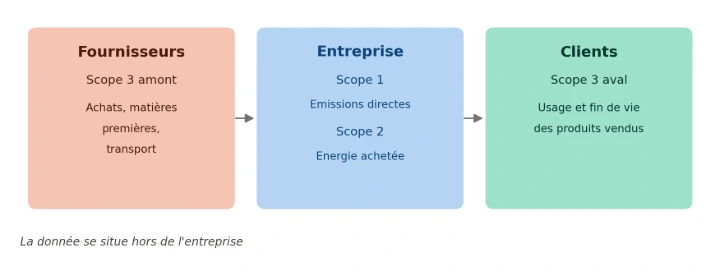
Most of the issues covered by the ESRS are based, directly or indirectly, on information from the value chain. This is particularly true for:
- greenhouse gas emissions related to purchases (Scope 3)
- the working conditions at suppliers
- the human rights in the supply chain
- the traceability of certain raw materials
- the practices of circular economy
- the policies of responsible purchasing
A new way to know your suppliers
For companies, this means moving from a logic of one-off collection to a genuine approach of understanding their supplier ecosystem. The question is no longer just: "Who are our suppliers?"
It becomes: What are the most critical? Which are the most exposed to ESG risks ? What data is actually reliable ? What elements can be documented ? Where are the main levers for progress ?
Vocabulary point :
Scope 3 : category of indirect greenhouse gas emissions, generated upstream or downstream of a company's activity — particularly those related to its purchases and supply chain.
Supplier ecosystem : the set of a company's suppliers considered not individually, but as a global network whose structure, risks, and interdependencies must be understood.
Data governance is becoming a maturity factor
As regulatory requirements progress, a new question arises: how to ensure the quality of the information used in reporting?
Useful data is data that is: recent, documented, traceable, comparable, understandable by all stakeholders.
This requirement is gradually bringing ESG data closer to the standards long applied to financial data. The quality of reporting now depends less on the number of indicators published than on the robustness of the data governance that feeds them.
The most mature companies are therefore not looking to collect more and more information. They implement processes that allow for data qualification, to verify their consistency, to retain associated evidence and to ensure their updating over time.
Procurement departments are becoming key players in sustainable performance
Procurement departments are no longer solely responsible for the economic performance of suppliers. They are also becoming data producers essential for managing the company.
Their ability to segment suppliers, collect relevant information, document evidence, and track improvement plans directly contributes to :
- the quality of CSRD reporting
- the reliability of decarbonization trajectories
- the management of ESG risks
- the regulatory compliance
- the resilience of the supply chain
Companies that are getting ahead on this issue are not just responding to a regulatory obligation. They are developing a better understanding of their suppliers, enhancing their anticipation capacity and building a more resilient against climate, regulatory, and economic challenges.
From compliance to value chain management
The CSRD not only asks companies to publish more information. It invites them to better understand their value chain and to sustainably structure the governance of their supplier data.
Companies that will make the most of this evolution will not necessarily be those that collect the largest volume of information. They will be those that know how to identify the truly useful data, validate it, document it, and transform it into decision-making tools.
In this context, supplier evaluation is no longer just a compliance exercise. It becomes a strategic lever to enhance the resilience of the supply chain, manage ESG commitments, and build sustainable performance based on reliable data.
Conclusion
At its core, the CSRD poses a simple question to companies: do you really know your value chain ?
For many organizations, the answer will no longer depend on the quality of their sustainability report, but on their ability to sustainably structure the collection, validation, and management of supplier data. It is on this capability that a large part of their ESG performance and their competitiveness.
Do you want to structure the collection and management of your suppliers' CSR data?
Scoring by Positive supports clients in deploying tailored evaluations — without charging your suppliers for the process.
Discover Scoring by Positive® Learn moreUne question ?
With the CSRD, suppliers' ESG data now feeds into sustainability reporting, climate strategy, risk management, and legal due diligence. Purchasing, CSR, Finance, Legal, and General Management rely on this same data for strategic decisions. Supplier data ceases to belong to a single department and becomes a shared asset across functions.
The ESRS (European Sustainability Reporting Standards) are the European technical standards adopted under the CSRD. They precisely define what sustainability information the companies concerned must publish — and in what format — regarding environmental, social, and governance dimensions, including those related to the value chain.
(Source: Delegated Regulation (EU) 2023/2772)
The Omnibus package is a set of European texts aimed at simplifying and easing certain obligations arising from the CSRD, without undermining its overall ambition. Published on February 26, 2026, and coming into force on March 18, 2026, it notably reduces the scope of the companies concerned (now those exceeding 1,000 employees AND €450 million in net revenue) and simplifies the ESRS standards. Compliance by member states is expected by March 19, 2027.
(Source: Directive (EU) 2026/470, OJ EU February 26, 2026)
Most of the issues covered by the ESRS are based on information from the value chain, including: GHG emissions related to purchases (scope 3), working conditions at suppliers, human rights in the supply chain, traceability of raw materials, circular economy practices, and responsible purchasing policies.