Reading time: 7 min
Ecrit par Hortense Battisti
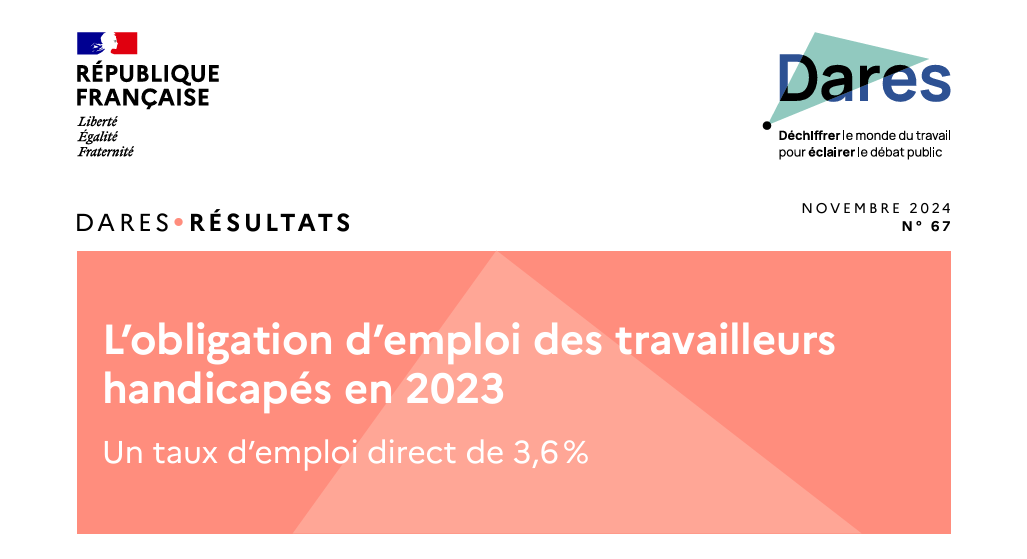
In 2023, the employment of people with disabilities in France remained a major issue, both socially and economically. Despite notable advances, challenges persist in achieving effective professional inclusion. A publication from DARES in November 2024 highlights these issues by providing a detailed analysis of data related to the employment of disabled workers in 2023. This analysis also identifies levers for action to improve their integration into the labor market.
The regulatory framework: the OETH, an opportunity and an obligation
Since the 2005 law, strengthened by the 2018 law, the Obligation to Employ Disabled Workers (OETH) requires companies with more than 20 employees to employ at least 6% of people with disabilities. In 2023, nearly 112,300 companies were subject to this obligation, representing a total workforce of approximately 454,200 full-time equivalents (FTE) of disabled workers, which corresponds to a direct employment rate of 3.6%, an increase compared to previous years.
Nevertheless, 31% of companies only reach the target of 6% of people with disabilities in their workforce through direct employment. To compensate for often insufficient direct employment, some companies partially fulfill their obligation through contracts with the protected and adapted sector or through other equivalent measures. In case of failure to meet their obligation through direct employment of disabled workers, companies must also pay a financial contribution that will be transferred to Agefiph.
A contrasting context for the employment of people with disabilities
Despite progress, people with disabilities continue to face difficulties accessing employment. Their unemployment rate remains high, at 12%, well above the national average, which is around 7%. Furthermore, in 2023, 45% of people with official recognition of their disability are active, compared to 74% of the entire population. (source: INSEE, 2023).
Representation of the unemployment rate of people with disabilities (as a percentage of the total population)
The figures also show disparities based on the size of companies. While large organizations tend to better meet the requirements of the OETH, small and medium-sized enterprises (SMEs) are sometimes hindered by financial or organizational constraints. These disparities illustrate the importance of tailored support for organizations of all sizes.
Existing tools and devices
1. Financial aids
To encourage the employment of people with disabilities, financial and technical aids are available, notably through Agefiph. For example, in 2023, 2,961 companies were supported by the Consulting and Support Offer (OCA) (source: Agefiph, annual report 2023).
Consulting and support for business creation or takeover | Agefiph
2. Adapted companies
The network of adapted companies (EA) continues to play a crucial role by welcoming nearly 45,000 disabled workers. These structures provide an adapted work environment and support employees in their skills development.
UNEA - National Union of Adapted Companies |
3. Awareness and training
Companies have also conducted awareness actions for their teams in 2023. These initiatives aim to deconstruct prejudices and promote a more inclusive environment.
Integrating people with disabilities is not just a matter of regulatory compliance. Companies that adopt inclusive policies benefit from greater internal cohesion and can enhance their employer brand.
Conclusion: a collective challenge for the future
The employment of people with disabilities remains a priority project for 2025 and beyond. While the numbers show a slow but real progression, it is essential to mobilize more stakeholders. The goal is clear: to enable every person with a disability who wishes to find a place in the workforce, while valuing their unique contribution.
Companies, supported by strong public systems, have a crucial role to play in transforming this challenge into a sustainable opportunity.
Click here to read the full report
Other sources mentioned: