
Clémentine Guérin
Reading time: 8 minutes
Why and how to act in favor of biodiversity?
May 22 marked the celebration of the International Day of Biodiversity, an opportunity to highlight the need to preserve our environment, of which the figures are concerning:
- 75% of the terrestrial environment is severely altered by human activities (UN)
- 1 million animal and plant species are at risk of extinction (IPBES)
- In France, 600,000 hectares of land are artificialized every ten years (OFB)
Too often forgotten in debates and environmental policies, the preservation of biodiversity must now be considered as a crucial issue by political leaders, businesses, and the global population, just like the fight against climate change.
The context
Since the publication in 2019 of the global assessment of the state of biodiversity and ecosystem services by the IPBES, it is undeniable that biodiversity is declining and that human activities are responsible. According to this study, over the last fifty years, 60% of natural habitats have been degraded, the rate of species extinction is at least 100 to 1000 times higher than the natural rate of extinction.
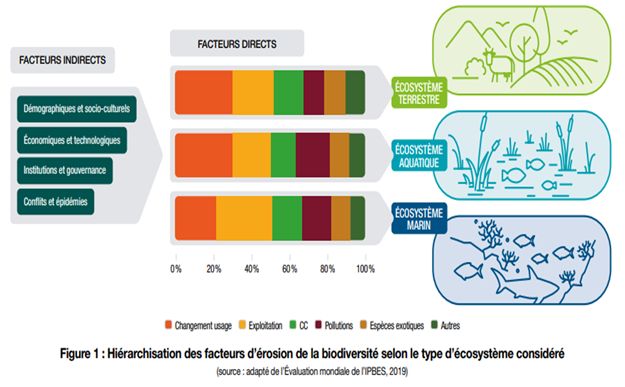
This erosion of biodiversity is mainly due to five interrelated factors, all linked to human activities:
- Land use change (artificialization of soils…)
- The exploitation of natural resources
- Climate change
- Pollution
- Invasive exotic species
The interdependencies between businesses and biodiversity
The businesses depend, directly or indirectly, on natural ecosystems and biodiversity.
Ecosystems provide businesses with natural resources such as water and agricultural raw materials. They also regulate essential natural phenomena such as temperatures and the filtration of rainwater into soils. Additionally, ecosystems offer cultural services such as outdoor activities and tourism. These ecosystem services are essential for the functioning of businesses, and according to the United Nations Environment Programme, they represent about 40% of the global economy.
Here are some examples of services provided by ecosystems to businesses:
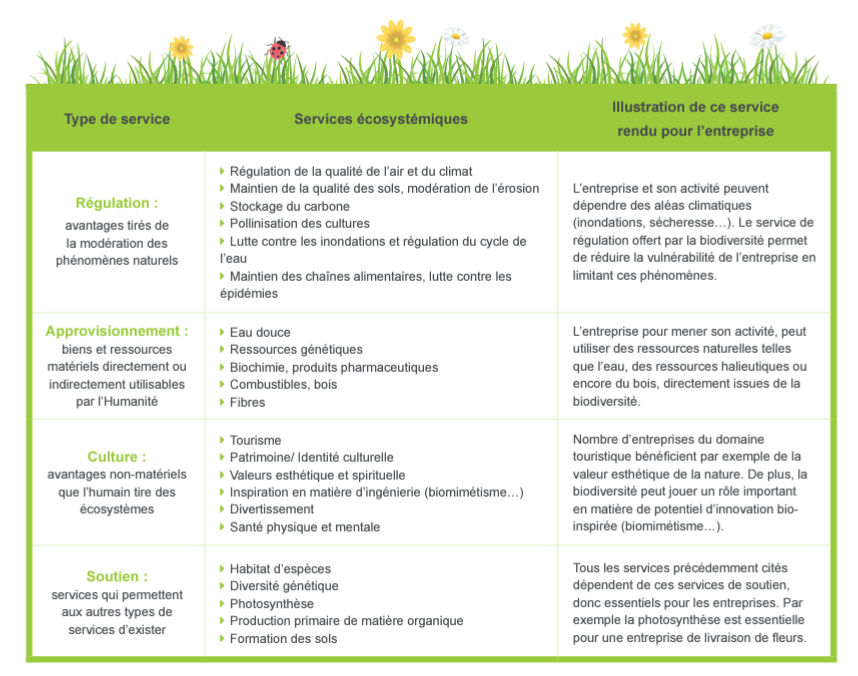
Source: Biodiversity and SMEs report, written by CPME and Committee 21
Considering biodiversity, opportunities for businesses
The issues related to biodiversity present both risks and opportunities for all businesses. The interdependence between biodiversity and business activities highlights the importance of these issues, both for nature and for the businesses themselves, which can derive numerous benefits from it:
- Value creation : Biodiversity plays a major role in the economy, with about 60% of global GDP moderately or strongly dependent on biodiversity (Swiss Re). Furthermore, the fight against the loss of biodiversity offers annual business opportunities of $10 billion, potentially creating 395 million jobs by 2030, according to the World Economic Forum.
- Innovation : Committing to biodiversity promotes innovation by seeking less impactful alternatives for biodiversity. The inspiration from biomimicry and nature-based solutions allows companies to integrate biodiversity issues and strengthen their resilience to climate uncertainties.
- Brand image and customer loyalty : Consumer environmental concerns are growing stronger. Demonstrating commitment to biodiversity and the environment allows a company to retain its customers, enhance its brand image, and meet the increasing demands of consumers regarding environmental responsibility.
- Quality of work life and employee engagement : Initiatives promoting biodiversity can raise awareness, engage, and unite employees within a company. Moreover, 83% of employees involved in a CSR initiative of their company recommend their employer (Parlons RH).
- Mastery of risks : Considering biodiversity allows access to grants and limits costs related to repairing environmental damage. Anticipating risks related to biodiversity helps secure the supply chain and production of the company. Moreover, biodiversity regulations are dense and evolving. It is therefore essential to pay particular attention to its actions regarding biodiversity protection to comply with this constantly evolving regulation.
Commitment to biodiversity: 4-step methodology
To voluntarily commit beyond regulatory requirements and integrate biodiversity into a CSR approach, it is important to follow certain steps:
1. Conduct a state of play
The company must assess the interactions between its activities and biodiversity by conducting a diagnosis. This allows understanding the impact of the company on biodiversity and its dependence on it along its value chain.
Different tools can be used to support this assessment :
- The interdependence indicator of the company to biodiversity (IIEB) which allows, through a self-diagnosis, to evaluate the importance of the proper functioning of ecosystems for maintaining the company's activity.
- The Global Biodiversity Score (GBS) is used to assess the biodiversity footprint of economic activities and financial institutions. It measures the impacts of the company's activities on biodiversity throughout its value chain.
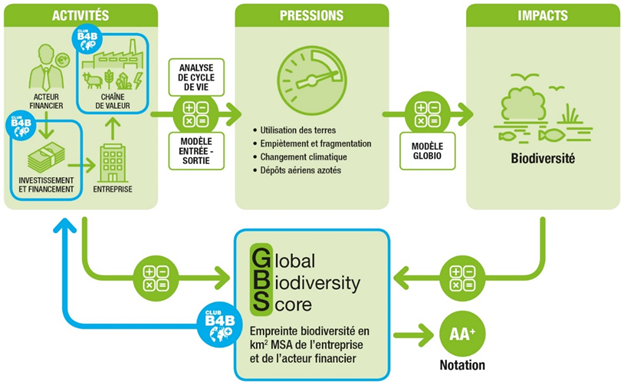
Source : Caisse des dépôts
2. Build an action plan
Once the impacts of the company on the biodiversity have been identified, the construction of a structured action plan allows for mobilizing teams and sustainably integrating the commitment to biodiversity into the company's strategy. To successfully carry out this approach, it is essential to involve management and engage employees, while working collaboratively with local stakeholders.
Here are some simple actions that can be implemented to protect the biodiversity and generate benefits for the company:
- Organize Fresco workshops : these fun workshops based on collective intelligence raise awareness of the issues related to the biodiversity, to the ocean or to forests, and teach your employees how to act to preserve them.
- Clean up together : With its program Ocean Initiatives, Surfrider Foundation – an organization rated 2 stars by Positive Company® for its CSR policy – offers[BT3] to participate in or organize clean-up collections of beaches, lakes, rivers, and seabeds. The president of Mégo, a company rated 2 stars by Positive Company®, created the association Terres Océanes, which organizes waste collection on the beaches. Cigarette butts – the most common waste found on our beaches in recent years – are then recycled by the company.
- Install beehives or create a garden on the company's roof : bees play an essential role in preserving the environment and pollination. Transforming green spaces or rooftops into gardens or installing beehives allows for the reintroduction of bees and protects biodiversity, as the EBRA group does.
- Preserve biodiversity in its territories : EBRA, the leading French regional daily press group certified CSR by Positive Company®, recently launched the project "Birds of Happiness" to contribute to the preservation of its territories and their biodiversity. It is based on a dual objective: to inform readers about the richness of the biodiversity of birds in our regions and also to raise awareness about endangered species and the civic actions to respect.
3. Evaluate your approach
To track the progress of the action plan and evaluate the achievement of set objectives, it is important to use "SMART" indicators (Specific, Measurable, Acceptable/Ambitious, Realistic, and Time-bound). These indicators are integrated into regular evaluations, allowing for the measurement of achieved results and identifying potential areas for improvement.
Here are examples of "SMART" indicators :
- Number of certified sites or products : "Increase the number of Biodiver’City® certified Building projects by 15% in one year."
- Number of partnerships : "Over the year, establish a new partnership with local naturalists."
- Percentage of greening : “Preserve 70% of the site's vegetation after the work carried out in 2024”.
- Number of awareness campaigns : we can identify as an objective “Involve 100% of employees in the Biodiversity Fresco in 2023”.
4. Enhance your approach
It is crucial to enhance and communicate the company's actions in order to raise awareness among internal and external stakeholders about the positive commitment undertaken. In addition to traditional communication methods such as social media and newsletters, initiatives can also be implemented through reward programs or labels.
Here are some examples :
- The program Committed Companies for Nature - act4nature France aims to identify, recognize, and enhance action plans in favor of biodiversity implemented by companies.
- The awards Companies and Environment, include a category that rewards companies that implement actions favorable to biodiversity.
- The B4B+ Club aims to define what constitutes a company contributing to ending biodiversity loss. The club produces content and tools tailored for companies and is divided into two working groups: “value chain” and “finance.”
- The working group Biodiversity and Economy of the ORÉE association aims to develop a decision-support tool to reflect on the links between energy transition and biodiversity-economy issues.
- You can also enhance your approach through specialized certifications or labels such as the AFAQ Biodiversity or the Ecocert Biodiversity Commitment but also with generalist CSR labels whose evaluation generally encompasses issues related to the preservation of biodiversity, as is the case with the Positive Company ® label.
The preservation of biodiversity is essential to ensure the sustainability of businesses, the economy, and human society. These recommendations aim to reconcile species conservation and production. Their implementation could be integrated into the future national strategy for biodiversity.
Sources :
- https://www.usinenouvelle.com/article/biodiversite-nouvelle-urgence-pour-les-entreprises.N2069582
- https://www.caissedesdepots.fr/blog/article/comment-les-entreprises-peuvent-elles-integrer-la-biodiversite-dan
- www.comite21.org/docs/doc-non-mis-en-ligne/2021/biodiversite-et-pme-vf-web.pdf
- https://www.strategie.gouv.fr/infographies/empreinte-biodiversite-entreprises
- https://www.vendredi.cc/ressources-articles/proteger-la-biodiversite-6-facons-de-mobiliser-son-entreprise