
Reading time: 4 minutes
Article published in February 2025, updated in August 2026
In this article, you will discover :
- How Petit Bateau masters its entire value chain in its historic factory in Troyes, from cotton thread to finished product
- Concrete investments made to reduce water and energy, with already -20% energy and -28% water by the end of 2023
- The ambitious goal of -95% water usage and carbon emissions by 2030, as part of a Scoring by Positive® assessment requested by La Redoute
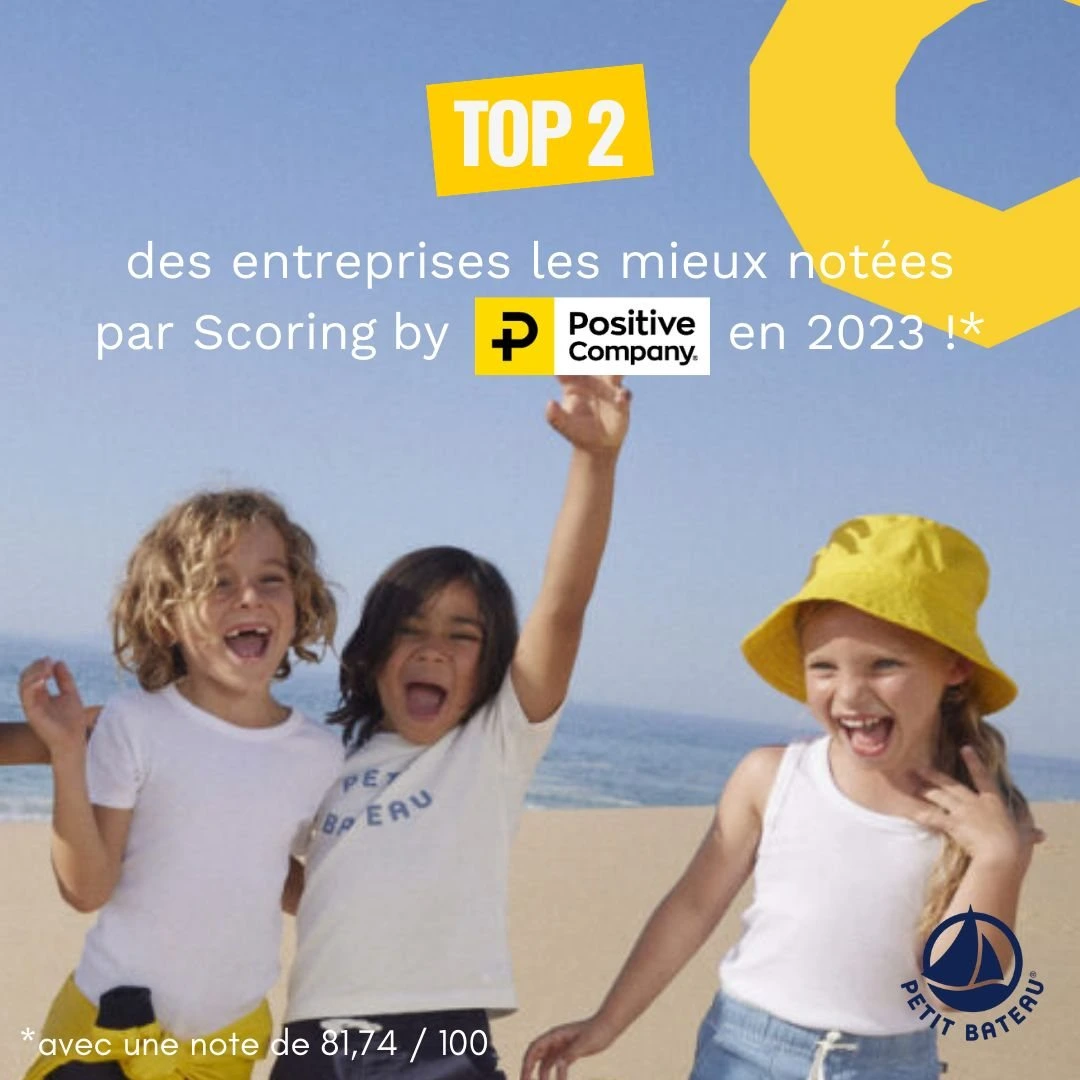
How to reconcile textile heritage and ecological transition? This is the challenge taken up by Petit Bateau, a brand born in Troyes in 1893 and labeled "Living Heritage Company" in 2023. Requested by La Redoute as part of Scoring by Positive, the company has demonstrated its commitment to sustainable fashion: control of the entire production chain in its historic factory, and ambitious goals for reducing water and carbon by 2030.
An industrial tool of excellence, labeled "Living Heritage Company"
In 2023, Petit Bateau receives the French state label "Living Heritage Company" (EPV), which distinguishes companies recognized for their economic excellence and exceptional artisanal or industrial know-how. This distinction crowns the brand's 130 years and highlights its efforts towards ecological transition.
The historic factory in Troyes masters the entire value chain, from cotton thread to finished product, through its various workshops: knitting, dyeing, digital printing, cutting, and sewing. A rare model in the textile sector, which allows Petit Bateau to control its environmental impacts at every stage of production.
Vocabulary point:
Living Heritage Company (EPV) : label awarded by the French State that distinguishes companies recognized for their economic excellence and exceptional artisanal or industrial know-how.
Pilot site : in this context, refers to a production site chosen to test and deploy new methods or technologies first, before a possible rollout to other sites of the company.
Energy sobriety : approach aimed at reducing the energy consumption of an activity by limiting unnecessary needs, rather than solely seeking to improve the efficiency of equipment.
A target of -95% water and carbon by 2030
A clearly quantified ambition
Petit Bateau aims to make its Troyes factory a pilot site for responsible production : reduce its water usage and carbon emissions by 95% by 2030 compared to the year 2019.
Concrete investments underway
Several structural investments have been made:
- Implementation of a demand-driven production system to reduce inventory
- Installation of a digital textile printing machine (2021)
- Investment in new cutting and dyeing machines (2022 and 2023)
- Implementation of heat exchangers, rainwater recovery, and wastewater recycling for use in industrial processes
- Installation of a new boiler (deployment until 2025)
Promising results already by the end of 2023
The initial results confirm the trajectory: -20% energy savings and -28% water savings by the end of 2023. Performances that illustrate the credibility of the 2030 target.
Who is Petit Bateau?
Information about the company
Brand born in Troyes in 1893, Petit Bateau is one of the major French brands in children's textiles. Requested by La Redoute as part of Scoring by Positive® — the CSR performance evaluation tool of Positive Company® — the company has demonstrated its commitment to sustainable fashion: control of the entire production chain in its historic factory, and ambitious goals for reducing water and carbon by 2030.
Key figures
1
95 %
reduction target for the use of water and carbon emissions by 2030 (compared to 2019)
2
20 %
energy savings already achieved by the end of 2023
3
28 %
water savings already achieved by the end of 2023
Petit Bateau, scored by La Redoute with Scoring by Positive®
Testimony from Petit Bateau
Conclusion
Through its historic factory in Troyes, Petit Bateau demonstrates that industrial heritage and ecological transition can move forward together. Awarded "Living Heritage Company" status in 2023, the brand relies on this recognition to transform its production tool into a pilot site for environmental responsibility.
With already tangible results by the end of 2023 — -20 % energy and -28 % water — and a goal of -95 % by 2030, Petit Bateau confirms, through its evaluation within the framework of Scoring by Positive®, its sustainable commitment to more responsible fashion.
Are you a client and want to assess the CSR performance of your suppliers in the textile or fashion sector?
Scoring by Positive® supports clients in deploying customized evaluations, without charging the process to your suppliers.
Découvrir Scoring by Positive® En savoir plusAny questions?
The label "Living Heritage Company" (EPV) is a distinction awarded by the French State to companies recognized for their economic excellence and exceptional artisanal or industrial know-how. It values French companies that hold a specific productive heritage, often rooted in a territory. Petit Bateau received this label in 2023, the year of its 130th anniversary.
Yes. The historic factory in Troyes integrates all stages of production, from cotton thread to the finished product: knitting, dyeing, digital printing, cutting, and sewing. This integrated production model is rare in the textile sector and allows Petit Bateau to control its environmental impacts at every stage.
Petit Bateau has set an ambitious goal: to reduce its water usage and carbon emissions by 95% by 2030, compared to the year 2019. As of the end of 2023, the initial results are already promising: -20% energy savings and -28% water savings.
Several structural investments have been made: on-demand production to reduce stocks, digital textile printing (2021), new cutting and dyeing machines (2022-2023), heat exchangers, rainwater recovery, wastewater recycling, and the installation of a new boiler (until 2025).