
Reading time: 10 minutes
Written by Florian Masseube
Chez NaTran, la réponse a été pragmatique : commencer par les partenaires qui concentrent l’essentiel des enjeux achats. Depuis 2023, l’entreprise s’appuie sur Scoring by Positive® pour évaluer la maturité RSE de ses fournisseurs stratégiques et agir sur trois priorités : la sécurité, l’éthique et le carbone.
On June 1, 2026, Laurent Torqueau, for the purchasing department of NaTran, and Charles Margnat, for Positive Company, discussed this approach, its initial results, and its next steps.
One clear lesson emerges: evaluating a supplier is only valuable if that evaluation allows for their improvement.
Key takeaways from the article
L’évaluation RSE des fournisseurs devient réellement utile lorsqu’elle débouche sur des plans de progrès concrets, et non sur une simple notation.
NaTran focuses its approach on its most strategic suppliers: its top 200 represents about 75 to 80% of its spending.
Safety, ethics, and carbon are the three reinforced priorities in NaTran's supplier evaluation.
With Scoring by Positive®, NaTran has an evaluation framework tailored to its business challenges to better manage its supplier risks and support their CSR maturity.
1. Prioritize suppliers with the greatest impact
With a base of over 3,000 suppliers, NaTran could have sought to launch a generalized evaluation campaign. The company made a different choice: to focus its efforts on its top 200 suppliers by purchasing volume, complemented by certain strategic partners outside this scope.
According to the information shared during the interview, these 200 suppliers represent about 75 to 80% of the company's spending on a total estimated purchasing volume of 600 million euros.
This targeting follows a simple logic: to act first where the risks and levers for transformation are the most significant.
À date, environ 250 fournisseurs ont été évalués, pour près de 275 évaluations réalisées, certains partenaires ayant déjà fait l’objet de plusieurs évaluations.
Parmi les 200 fournisseurs prioritaires, environ 150 ont déjà été évalués, soit près de 75 % du périmètre ciblé.
2. Evaluate CSR in light of business challenges
A supplier evaluation cannot remain generic when it needs to inform operational decisions.
In the case of NaTran, three topics have been reinforced in the system: safety, ethics, and carbon.
La sécurité
Pour une entreprise intervenant sur des infrastructures et des activités techniques, la sécurité des personnels et des prestataires constitue un enjeu central. L’évaluation doit donc permettre d’identifier la maturité des fournisseurs en matière de prévention, de formation, de règles d’intervention et de suivi des indicateurs de fréquence et de gravité des accidents.
L’éthique
La robustesse d’une relation fournisseur dépend aussi de la capacité à prévenir les risques de corruption, de conflits d’intérêts ou de non-conformité. Les dispositifs anticorruption, les règles de gouvernance et les éléments de preuve associés participent directement à la maîtrise du risque fournisseur.
Le carbone
Enfin, la décarbonation d’une entreprise dépend largement de sa chaîne de valeur. Pour agir sur les émissions indirectes, NaTran doit progressivement mieux connaître la maturité carbone de ses fournisseurs : existence d’un bilan d’émissions, couverture des scopes pertinents, trajectoire de réduction et actions engagées.
It is on this point that the customization of Scoring by Positive® makes complete sense. The solution is based on a structured CSR evaluation framework, complemented by a set of questions tailored to the priorities of the client. In the NaTran system, this approach thus enhances the understanding of safety, ethics, and carbon issues.
3. A score as a starting point, not as a sanction
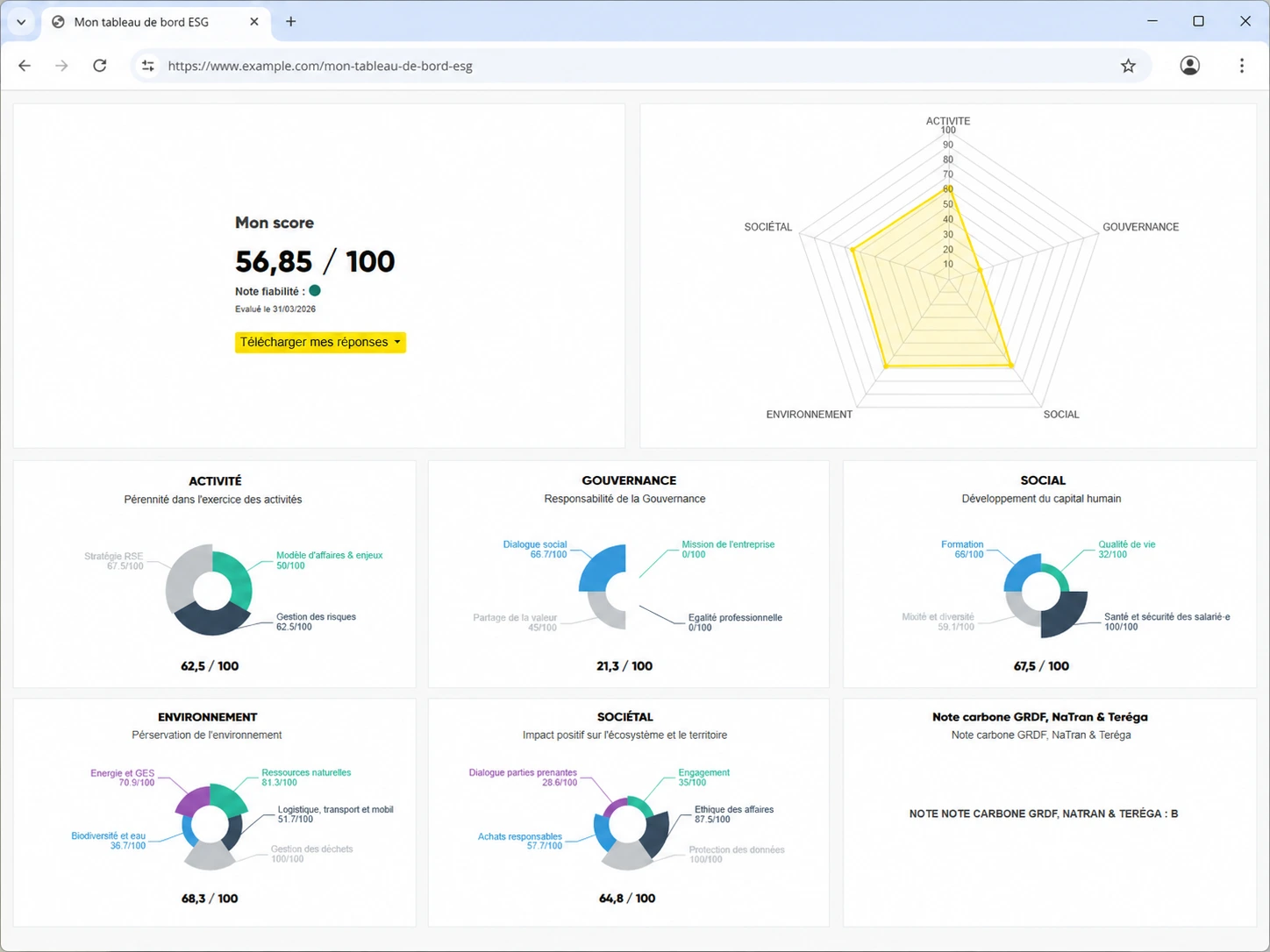
La note moyenne des fournisseurs évalués se situe aujourd’hui autour de 55/100.
But the value of the system does not solely lie in this average. A score indicates a level of maturity; it does not, by itself, transform a supplier's practice.
The approach taken by NaTran is based more on a logic of progression. It is not about immediately dismissing a partner who is insufficiently advanced, but about identifying priority actions and building improvement plans, generally over a horizon of about one year.
On carbon, a supplier who does not yet have an emissions report may be invited to structure this first step and identify their reduction levers.
On safety, actions may focus on golden rules, training, feedback, or monitoring site indicators.
On ethics, they may concern the formalization of an anti-corruption system or the production of evidence of compliance.
In other words, the evaluation is not designed as a guillotine, but as the starting point of a more demanding and useful dialogue.
This philosophy is also reflected in the idea of valuing the progress of suppliers, rather than only distinguishing those who already have the best scores. Recognizing improvement trajectories allows for more partners to be engaged in the process.
4. Engaging suppliers without burdening their daily lives
The deployment of a CSR evaluation quickly confronts a reality: not all suppliers have the same resources to respond.
Some large companies have already structured their CSR policies and can quickly provide the requested elements. Others, however advanced, express a form of fatigue in the face of the multiplication of questionnaires from different clients.
For SMEs and micro-enterprises, the situation is often different. Some have good practices but little time to formalize them. Others see the evaluation as a way to highlight their commitment and differentiate themselves in consultations.
Since 2023, NaTran has therefore proceeded with waves of onboarding, with launch webinars and invitations gradually sent to the concerned suppliers.
L’accès gratuit à la plateforme pour les fournisseurs constitue également un élément important du dispositif : il vise à réduire les freins à la participation, en particulier pour les entreprises de plus petite taille.
Cette attention est déterminante. Une politique d’achats responsables ne peut réussir durablement si elle fragilise les partenaires qu’elle souhaite mobiliser.
5. Incorporating CSR into purchasing decisions
The other major issue is to use the results of the evaluation in the daily practices of the purchasing teams.
Chez NaTran, environ 65 % des consultations intégreraient aujourd’hui un critère RSE, avec un objectif de 100 % en 2030. La démarche doit donc progressivement passer d’un pilotage centralisé à une appropriation plus large par les acheteurs.
The purchasing team has about 35 buyers, including about ten category or segment buyers who are called to play a role in the facilitation of the system.
Data from Scoring by Positive® is also starting to be used in dashboards and in Power BI. The goal is to better track evaluations over time, identify priority improvement plans, and have a consolidated view of strategic suppliers.
At this stage, the evaluation becomes more than just a questionnaire: it becomes useful data to guide consultations, business reviews, and category strategies.
6. Reducing supplier fatigue: the interoperability project
An issue that is set to gain importance: the pooling of evaluations.
When a supplier works for several players in the same sector, they may be required to respond multiple times to comparable requests regarding their carbon footprint, social policies, governance, or ethical practices.
This repetition takes up time without necessarily accelerating progress.
The possibility of sharing or further recognizing evaluations among players in the energy sector, including NaTran, Teréga, or GRDF, is already underway with Scoring by Positive.
7. Evaluate to transform
NaTran's feedback shows that a CSR supplier evaluation approach can go beyond mere compliance.
By targeting its strategic partners, strengthening the issues directly related to its activities, and prioritizing improvement plans, the company is gradually transforming evaluation into a purchasing management tool.
For Positive Company, this feedback also illustrates the purpose of Scoring by Positive® : to help clients understand the CSR maturity of their partners, prioritize their risks, and engage in concrete improvement trajectories.
The next challenge will be scaling up: continuing evaluations, strengthening buyer ownership, further integrating data into management tools, and reducing the burden on suppliers through greater interoperability.
Because a responsible value chain is not built solely through requirements. It is built by the ability of a client and its suppliers to progress together.
Et dans votre organisation, l’évaluation RSE fournisseurs est-elle encore un exercice de reporting, ou est-elle déjà devenue un véritable levier de transformation ?
Defining your strategic suppliers is neither a declarative exercise nor a simple accounting sorting.
It is astructured arbitrationbetween:
- your business sector,
- your geographic dependency areas,
- your financial exposure,
- and your CSR challenges.
This work today forms the basis of a credible supplier risk management policy, but also aclear marker of maturityin any demanding CSR labeling approach.
Because in terms of the value chain, a responsible company is not one that monitors everyone. It is one that knows preciselywhom to monitor, why, and with what level of requirement.