
Reading time: 8 minutes
Written by : Manoëlle Dousson
Since its launch, ChatGPT has experienced explosive adoption: over 300 million weekly active users. But behind this digital revolution lies a less visible reality: the carbon footprint of artificial intelligence.
A simple AI query consumes 6 times more energy than a Google search. And generating a high-definition image consumes as much energy as fully charging a mobile phone. On a large scale, this represents thousands of tons of CO₂ emitted every day.
Yet AI is very useful in our daily lives, especially in business. So, how can we benefit from it while mitigating its environmental impact?
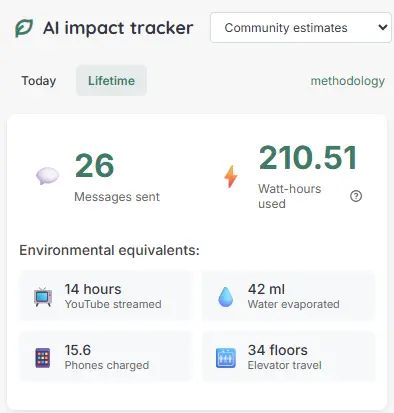
Extension AI Impact Tracker to visualize in real time the environmental impact of your use of ChatGPT
1. Do not replace your usual tools with ChatGPT
The most effective way to reduce the environmental impact of AI... is simply not to use it when it's not necessary. Before launching ChatGPT, ask yourself: could I get this answer another way, more simply?
- Need a precise definition? → Google or better yet, a more ethical and eco-friendly search engine (Ecosia, Lilo, Ecoengine) remains the most sustainable tool. As we have seen, an AI query consumes 6 times more energy than a Google search.
|
|
|
| |
Allows the choice of the project to support | | |||
Works with renewable energy | ||||
Privacy (does not collect data) | ||||
French |




Comparison of Eco-Friendly Search Engines (Climate Consulting)
- Need a quick translation ? → DeepL or Google Translate sont plus efficaces. Pour une traduction ChatGPT, vous utilisez autant d'énergie que pour six traductions Google.
- Need an image ? → Prefer Google Image, online banks (Unsplash, Pexels) or specialized generators like Napkin.ai. Et quel que soit l'outil utilisé, faites attention aux droit d'auteur !
- Des questions environnementales ? → utilisez ClimateQ&A qui se base uniquement sur les rapports du GIEC. Vous aurez des réponses plus scientifiquement correctes et l'IA n'aura pas à chercher
Generative AI should be reserved for high-value use cases, not trivial queries.



2. If you use ChatGPT, use it wisely
Each interaction with an AI consumes resources. Therefore, avoid the unnecessary. The clearer your prompts are, the more relevant the response will be, and the less you will need to re-prompt the model.
2.2 Master the content
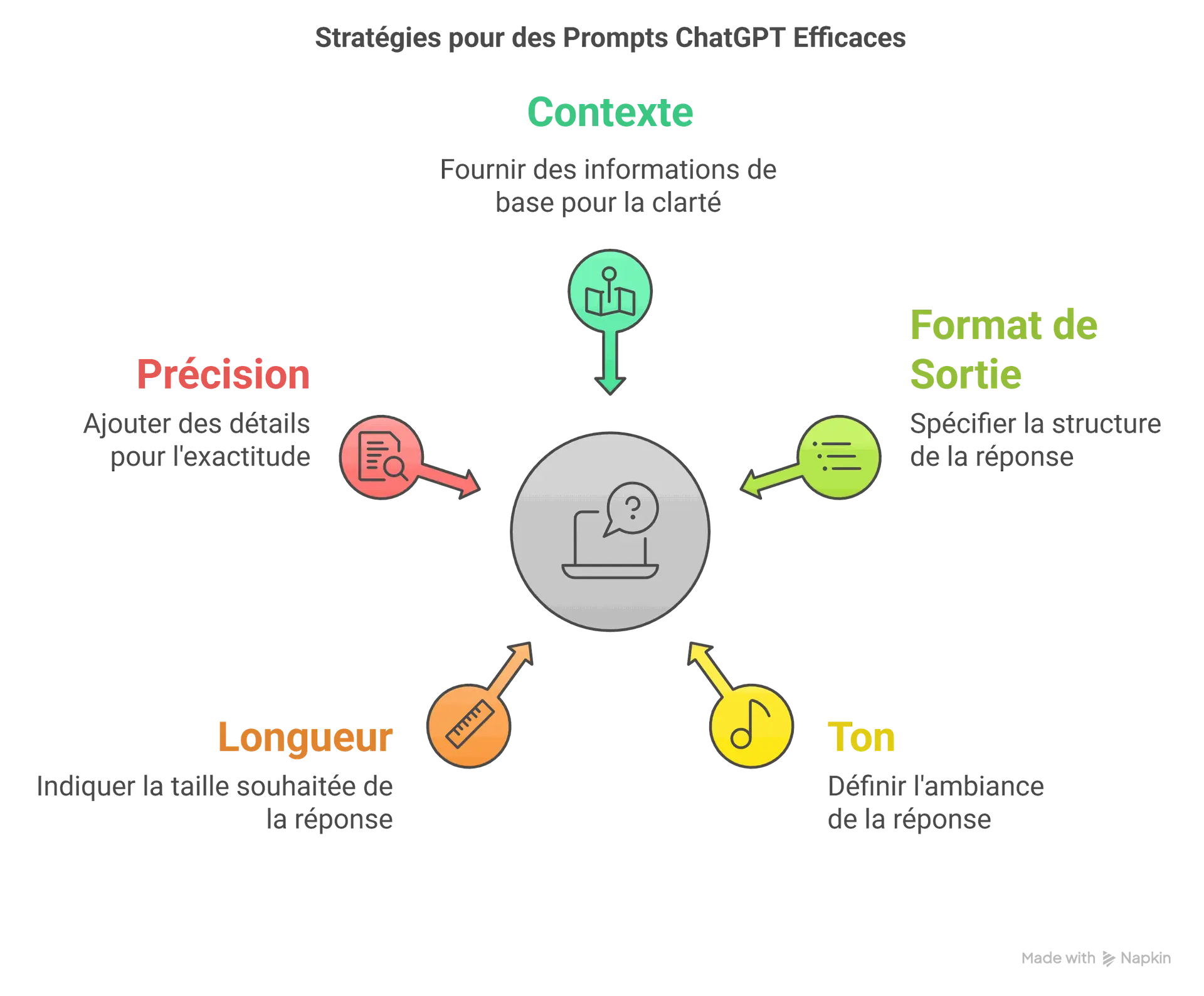
The quality of an answer directly depends on the quality of the question. To optimize your prompts, make sure to :
Provide the context (objective, target audience, constraints).
Example: "I want to write a Python code to calculate my environmental impact. Here’s how I want to approach it…"
Specify the output format (bullet points, short paragraph, code, table, etc.).
Example: instead of asking "Give me a summary of the report," rather phrase it as "Write a 200-word summary of report X, intended for a management committee, in the form of clear bullet points."
Specify the expected tone (professional, educational, creative).
Indicate the desired length.
Indicate any details that ChatGPT cannot infer from reading your prompt, without which it will not respond accurately.
Example: instead of saying "Give me an Excel formula that...", rather phrase it as "In cell XX of Excel, give me a formula that references cells X and Y where there are...".
2.1 Master the form
ChatGPT is a predictive model. It therefore uses both the content of what you tell it and the way you express it.. So write complete and rather short sentences. Don’t hesitate to write in paragraphs and go to the next line.. ChatGPT is like a human: if you don’t explain your request in the right order, it may give you an inadequate response.
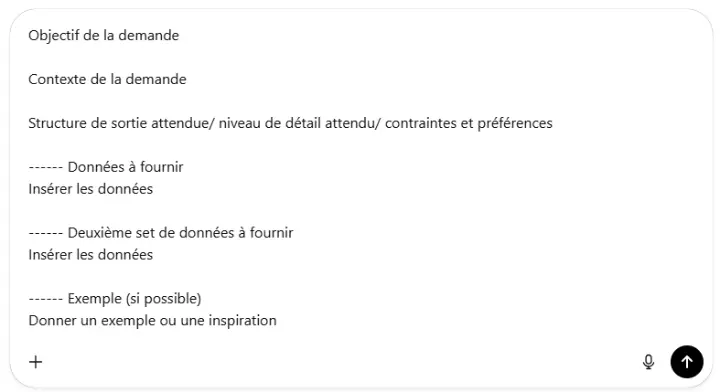
A good piece of advice to follow (both to make it easier for you to review prompts and for ChatGPT itself) is to put the appendices last with clear spacing.
Exemple:
3. How to make your surroundings feel guilty
The sober use of AI is not just an individual matter, it is also a collective approach. When you implement the tips we just discussed, that’s good. But when your colleagues do the same, that’s better!
Share the right tools. In my case, showing my colleagues the AI Impact Tracker extension—which visualizes the environmental impact of using ChatGPT in real time—was a game-changer. They quickly realized that their use of ChatGPT—occasional but daily—had a greater impact than they had realized..
If you are very motivated, ask to participate in workshops, like theA digital landscape. It allows us to look beyond the impact of AI by examining our use of digital technology as a whole.
And if you want to test more subdued AIs, try the AI comparator Comparia.



En conclusion
Artificial intelligence is a tremendous lever for productivity and innovation. But its environmental cost requires the development of sober and responsible practices. By adopting simple reflexes, favoring the right tools, getting straight to the point, writing complete and precise prompts, you can significantly reduce your digital footprint.
Sources / to go further
- Figures on AI : Regional Academic Direction for Educational Digital, PromptEasy
- DIALOG Method : Cegeos
- Science Po Environment : short video on the environmental impact of ChatGPT
- Interview with Jean-Marc Jancovici by Hugodécrypte (from 46min) : Will humanity make it? Interview with Jean-Marc Jancovici