Reading time: 10 minutes
Written by Lucie Lemonnier
Double materiality is the principle that lets a company identify its important sustainability issues from two points of view: its impacts on people and the environment, and the effect of those issues on its financial position. It is the starting point of the sustainability reporting required by the CSRD, the European directive on sustainability reporting. This article gives the definition, a six-step method, an example matrix and what the 2026 texts change.
Double materiality: key takeaways
| Topic | Key point |
|---|---|
| Definition | Double materiality has two dimensions, impact materiality and financial materiality, whose interactions the company must consider. |
| Material issue | An issue can be material on impact alone, on financial grounds, or on both. |
| Who is concerned | For financial years starting on or after 1 January 2027, the CSRD targets companies with more than 1,000 employees on average and more than EUR 450 million in net turnover. |
| Method | Six steps: context, impacts, risks and opportunities, stakeholders, assessment, thresholds, validation and documentation. |
| Update | At each reporting date, the company checks whether significant changes alter its conclusions. |
| Companies with 1,000 employees or fewer | They are protected by the value chain cap: a voluntary standard limits what their customers can ask of them. |
What is double materiality?
The ESRS 1 standard (European Sustainability Reporting Standards), which sets the reporting principles of the CSRD, defines two dimensions: impact materiality and financial materiality. An impact can be financially material from the outset, or become so; it can also be material on impact alone. Financial materiality extends the notion of materiality used to prepare financial statements (paragraphs 35 and 46).
| Impact materiality | Financial materiality | |
|---|---|---|
| Question asked | What are my effects on people and the environment? | What effects do sustainability issues have on my financial position? |
| What is assessed | Positive or negative, actual or potential impacts linked to activities and to the upstream and downstream value chain | What can affect financial performance, cash flows, access to finance or the cost of capital |
| For whom | The topic is assessed from the point of view of people and the environment | Users of financial information who decide whether to provide resources to the company |
In French, it is called double matérialité.
What the 2026 texts change for the analysis
Three European texts date from 2026. The paragraph numbers cited below are those of the ESRS 1 standard as amended by the first of them.
- Delegated Regulation (EU) 2026/1563 of 3 July 2026 amends the ESRS to simplify several of them. The double materiality principle remains in ESRS 1.
- Directive (EU) 2026/470 of 24 February 2026, known as the Omnibus, limits the reporting obligation to companies with more than 1,000 employees and more than EUR 450 million in net turnover. For financial years starting on or after 1 January 2027, the scope is the one defined by this text. Member States must transpose it by 19 March 2027 at the latest, and France has not yet done so.
- Delegated Regulation (EU) 2026/1560 of 3 July 2026 sets a voluntary sustainability standard for companies protected by the value chain cap, that is, those with no more than 1,000 employees on average. Customers subject to the CSRD cannot require more of them than this cap for their sustainability reporting, as detailed in the article on the voluntary standard and SMEs.
The full timeline is in the overview of CSR regulations 2025-2026.
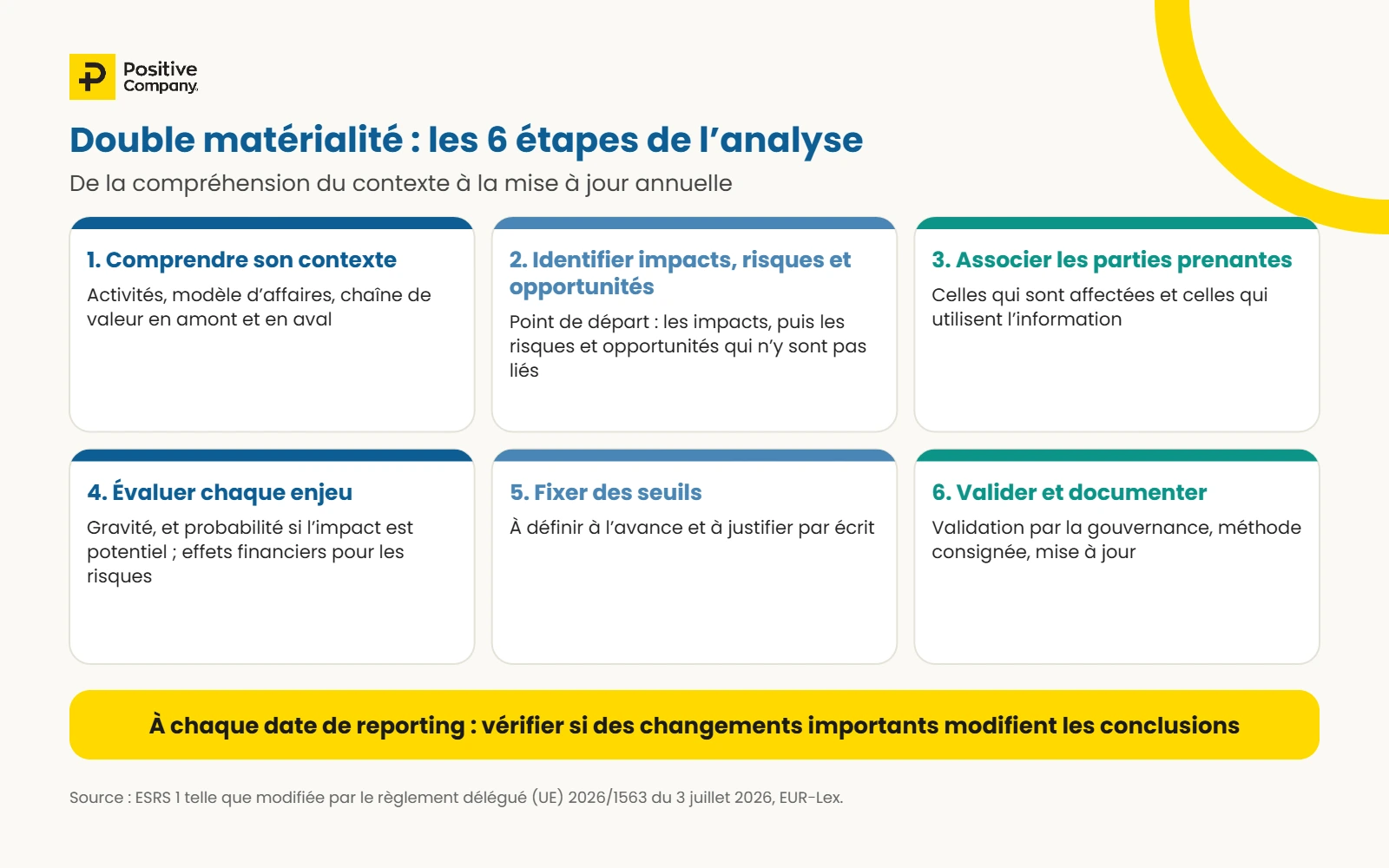
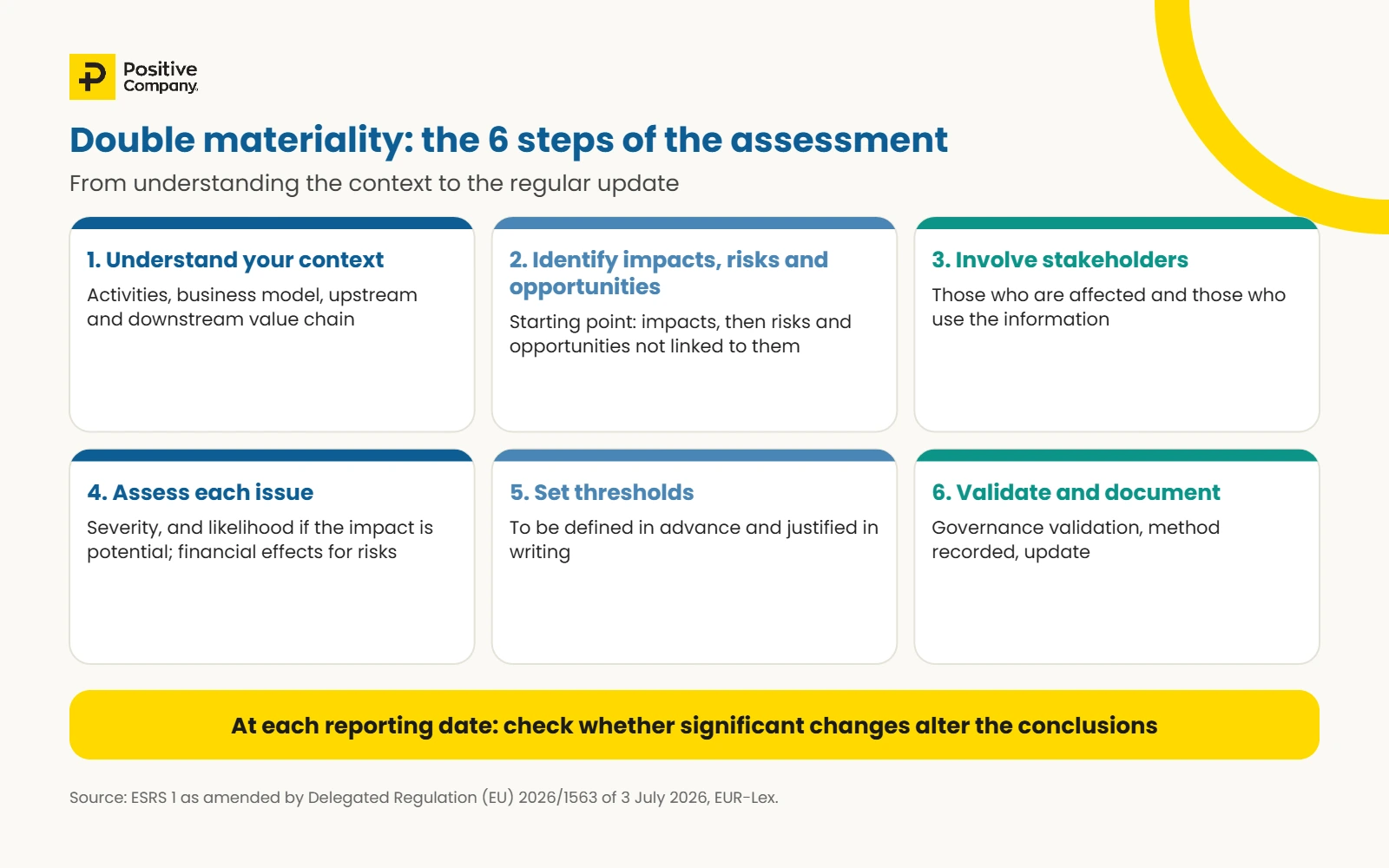
How to carry out a double materiality assessment in six steps
- Understand your context. Activities, business model, locations and value chain, upstream and downstream. According to ESRS 1, the impacts to consider include those linked to products, services and business relationships, which are not limited to direct contractual relationships (paragraph 39).
- Identify impacts, risks and opportunities. The starting point is generally the assessment of impacts; the company also assesses risks and opportunities not linked to them (paragraph 36). The ESRS sustainability topics serve as a grid, supplemented by sector-specific issues.
- Involve stakeholders. Those affected by the activity (employees, suppliers, local residents) and those who use the information (investors, banks). Knowing how to identify and prioritise your stakeholders determines the quality of the result.
- Assess each issue. For an actual negative impact, materiality depends on severity; for a potential negative impact, on both severity and likelihood (paragraph 40). For a risk or opportunity, its financial effects are estimated.
- Set thresholds. You must decide in advance from what level an issue is retained, and write down why.
- Validate and document. Governance validates the result and the method is recorded. At each reporting date, the company checks whether significant changes alter its conclusions and, if so, reviews its assessment (paragraph 34).
The double materiality matrix
The matrix puts financial materiality on one axis and impact materiality on the other. It must show the rating scales, the threshold chosen, the issues above and below that threshold, and the reason for those set aside. A ranked list can play the same role.
Here is an illustrative example, for a print media company. The scores are fictitious, on a scale from 1 (low) to 4 (high), with a threshold of 3.
| Issue | Impact score | Financial score | Material? |
|---|---|---|---|
| Paper sourcing (forests, price) | 4 | 4 | Yes, on both axes |
| Working conditions at subcontracted printers | 3 | 2 | Yes, on impact |
| Energy cost of printing plants | 2 | 4 | Yes, on financial grounds |
| Water use in offices | 1 | 1 | No, documented then set aside |
Examples: ARPP and Reworld Media
In September 2023, two CSR managers gave testimonials during a Positive Company webinar.
ARPP, an association of 25 employees outside the scope of the CSRD, voluntarily chose double materiality: to speak the same language as its partners and members subject to the CSRD, to anticipate future reporting requests and to structure its CSR approach around priority issues. Positive Company supported it at the time: an anonymous questionnaire sent to stakeholders, weekly project follow-up and a summary of results to build the matrix. Positive Company no longer offers this type of support since the end of 2025.
Reworld Media, a media group of 73 subsidiaries already subject to the non-financial performance statement, proceeded step by step: training on the methodology, identifying topics with the CSR department and governance, mapping stakeholders, then questions on the scope to adopt for the CSRD and the carbon footprint. Its CSR manager had this phrase about supply chains: “we are all someone else’s scope 3”.
Mistakes to avoid
Starting from a generic list without looking at your value chain means missing impacts located at suppliers. Consulting only your employees leaves out suppliers and local residents. Confusing the importance perceived by stakeholders with materiality skews the assessment: consultation informs it, it does not replace it. An assessment without written thresholds or method does not withstand a review, and one done only once becomes outdated: ESRS 1 requires reviewing it when significant changes occur.
Double materiality, the Label and supplier assessment
The Positive Company® Label is not a double materiality assessment and does not replace it. It relies in particular on anonymous surveys of the company’s stakeholders, material that some companies can link to the consultation step of their own assessment.
Discover the Positive Company® label Learn moreFor a customer subject to the CSRD, upstream impacts sit with its suppliers. Supplier CSR assessment by Scoring by Positive® provides data on them. For suppliers with 1,000 employees or fewer, the value chain cap limits what can be requested for CSRD reporting, not requests made for other purposes, such as risk management or due diligence required by the Union.
Discover Scoring by Positive® Learn moreFrequently asked questions about double materiality
It is the principle of identifying your sustainability issues from two perspectives: the company’s impacts on people and the environment, and the effects of those issues on its financial position. According to ESRS 1, the company must consider the interactions between these two dimensions to determine the information it reports.
Impact materiality aims to identify the company’s main impacts, positive or negative, actual or potential, including in its value chain. Financial materiality identifies the information that is material for users of financial information who decide whether to provide resources to the company.
You identify impacts, risks and opportunities, consult stakeholders and score each issue on both axes. You then set a threshold and place the issues on the matrix: those that exceed the threshold on one axis, or both, are retained. The justification for each score and for the threshold must be kept.
It is for companies that report under the CSRD. For financial years starting on or after 1 January 2027, the Omnibus directive limits this scope to companies with more than 1,000 employees on average and more than EUR 450 million in net turnover. France has not yet transposed this text, which is due by 19 March 2027.
Not under the CSRD. It is protected by the value chain cap: its customers subject to the CSRD cannot require, for their sustainability reporting, more than the data provided for by the voluntary standard in Delegated Regulation (EU) 2026/1560. It can carry out the assessment on its own initiative to set its CSR priorities, as ARPP did.
At each reporting date, the company checks whether significant changes have occurred that could alter its previous conclusions. If so, it reviews its assessment and updates it. These changes may come from its activities, structure, business relationships, assessment methods or external environment.
Sources:
- Commission Delegated Regulation (EU) 2026/1563 of 3 July 2026 amending Delegated Regulation (EU) 2023/2772 (EUR-Lex, consulted 21 October 2026)
- Directive (EU) 2026/470 of the European Parliament and of the Council of 24 February 2026 (EUR-Lex, consulted 21 October 2026)
- Commission Delegated Regulation (EU) 2026/1560 of 3 July 2026 (EUR-Lex, consulted 21 October 2026)