
Reading time : 7 min
Written by Benjamin Morand
On Monday, January 20, Stéphane Séjourné, European Commissioner for Prosperity and Industrial Strategy, discussed on France Inter the idea of "eliminating reporting." Not without connection to the so-called "omnibus" bill aimed at making Europe competitive in the face of international challenges, this statement has ignited the world of CSR and has been the subject of much speculation. In this article, you will find a summary of the main impacts to expect on the CSRD through the application of the omnibus law.
Why an omnibus bill ?
In a context where the European Union seeks to maintain its competitiveness against increasingly high-performing international economies, the omnibus bill is part of a comprehensive strategy for harmonization and simplification of rules. This text aims in particular to adapt existing regulations to make them more accessible and pragmatic, while aligning standards with the climate and social objectives set by the European Green Deal. Among the topics addressed, the CSRD is a central pillar.

What impacts on the CSRD ?
If nothing has been finalized yet regarding this law, many speculations are circulating on the networks and it can be difficult to know what to expect. In order to have an overview of the main upcoming changes regarding the CSRD, Positive Company conducted a study consolidating the positions of various key stakeholders in this debate, such as MEDEF, Business Europe, or AFEP, as well as the position of France, Germany, and the European Commission. The omnibus law has not yet been officially published, so the results of this study should of course be taken with caution.
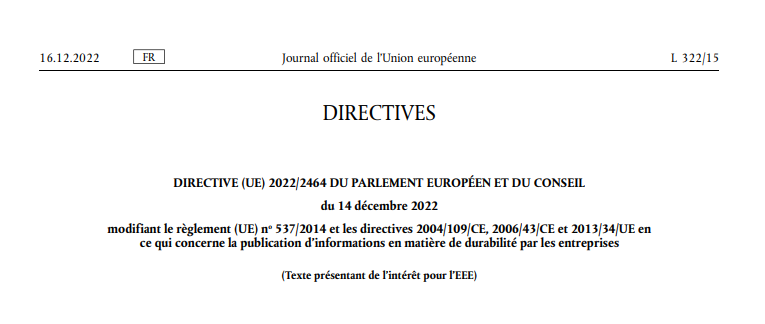
The main points that emerge from this study and that can be expected are as follows :
- The CSRD would indeed remain in force. However, the omnibus law would simplify reporting obligations for companies, particularly for SMEs and "small mid-caps".
- The CSRD would maintain its principle of extra-territoriality, meaning that all foreign companies operating in Europe would have to comply.
- At the level of the value chain, a adjustment of due diligence obligations would be made to avoid an administrative overload, by capping the reporting requirements imposed on subcontractors. Large companies indeed transfer their obligations to their smaller partners. The goal would therefore be to limit this cascading effect by adjusting the obligations so that they are proportional to the size and capabilities of the companies.
- Double materiality would remain a key principle of the CSRD. However, the requirements for double materiality would be adapted to the size and capabilities of the companies.. There could also be more flexibility in prioritizing priorities based on sector-specific characteristics.
- The gap analysis would remain an essential phase of the CSRD. but it should focus on the most relevant ESG data, particularly those related to double materiality and climate goals.
- In terms of indicators to report, the Omnibus bill would aim to reduce reporting obligations by 25% for large companies and 35% for SMEs.. The goal would be to prioritize indicators that have a direct impact on climate, environmental, social, and governance objectives:
- Environment: Simplified/less demanding Scope 3 for SMEs and "small mid-caps." and prioritization of data on direct emissions (Scope 1) and indirect emissions related to energy (Scope 2).
- Social: reduction of detailed indicators on working conditions in the supply chain. and focus on essential data, such as pay gaps, diversity, and inclusion.
- Governance: indicators on the composition of boards of directors or anti-corruption policies could be standardized to reduce variations in interpretation.
For the timeline for publishing the sustainability report, transitional measures or deadline adjustments would be considered to allow for a gradual implementation. SMEs in particular, could see their publication deadlines postponed.
Finally, the European Commission would propose an integration of existing frameworks (CSRD, EU taxonomy, CS3D directive) to standardize reporting requirements. The simplifications would include a harmonization of European sustainability standards (ESRS) with other international frameworks to reduce fragmentation and compliance costs.
To go further
For a more in-depth analysis, it is possible to access our study containing a summary of positions by types of stakeholders.
Download the full study
What to conclude ?
The omnibus bill could well redefine certain strategic aspects of the CSRD and lay the groundwork for sustainable European competitiveness. However, significant uncertainty remains until the European Commission publishes the final text. The CSRD would still be maintained, but with simplifications intended to lighten administrative burdens. The uncertainty complicating planning, it remains necessary to stay informed.