
Reading time : 7 min
Written by Violette Tomorrow
To meet social and environmental requirements, some companies consider implementing a responsible purchasing policy a priority. Indeed, in light of the expectations of all stakeholders and an increasingly demanding regulatory context, it is now essential to engage in such an initiative, both from the purchasing departments and the suppliers' side. The latter, just like the company and the end buyer, have a considerable environmental, social, and societal impact that must be taken into account in the company's overall strategy.
To illustrate this idea, let’s take the case of a company's carbon footprint: scope 3, which encompasses all emissions produced by the various stakeholders (suppliers, partners, customers, etc.), represents 80 to 90% of a company's total emissions. It is therefore understood that if a company truly wishes to reduce its carbon footprint, it must consider its entire value chain. Thus, implementing a responsible purchasing policy presents itself as an extremely effective lever for the company. This approach involves integrating environmental and social criteria into the purchasing process. It allows companies to make conscious and ethical choices when purchasing goods and services, while taking into account their impact on the environment, workers, and society as a whole.
This article, written in the form of a guide, will therefore present the different steps to follow to implement such an approach within your company.

THE DIFFERENT STEPS
Implementing a responsible purchasing strategy involves completely rethinking its purchasing strategy, and this goes through different steps.
Step 1 : Conduct a status report and needs analysis
Before embarking on the implementation of a responsible purchasing policy, it is essential to conduct a complete audit of existing practices and analyze the company's needs. This status report will take into account the social, environmental, and economic impacts generated by the company's purchases and move in the right direction.
Step 2 : identify areas for improvement and develop a strategy
The status report then allows the company to build a purchasing strategy. To do this, it must first determine the areas for improvement, set clear, measurable, and prioritized objectives, and then establish the strategy and the resulting action plan.
The company must also evaluate the achievement of objectives by defining key indicators that will be used to manage and monitor the strategy. The Observatory of Responsible Purchasing has also defined 14 relevant indicators to use, which you can draw inspiration from. To name a few :
- percentage of suppliers that have undergone a CSR audit
- percentage of purchases for which an environmental, social, and/or societal criterion is required
- percentage of buyers trained or made aware of responsible purchasing[VD1]
Step 3 : Select responsible suppliers
This is a key step in your responsible purchasing approach as it allows for the identification and selection of suppliers that align with your strategy and values. It is a very important process, consisting of several distinct sub-steps.
First, it is essential to define your responsibility criteria. They can encompass various aspects such as regulatory compliance, sustainable practices, working conditions, transparency, environmental protection, etc. You can also rely on the multiple CSR certifications and labels to guide your search.
Evaluation Criteria
Examples of evaluation criteria for supplier performance in terms of social responsibility
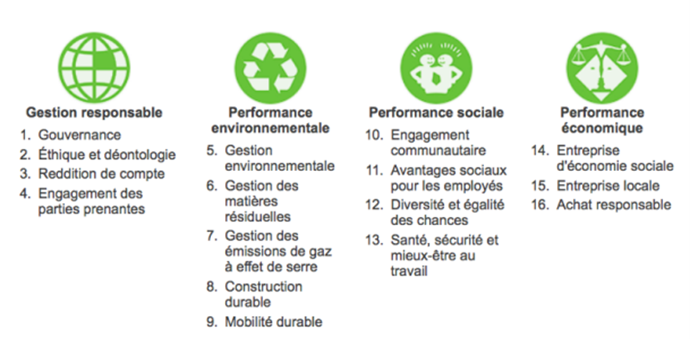 https://www.desjardins.com/a-propos/espace-fournisseurs/
Subsequently, a sourcing and evaluation of suppliers is necessary. For this, there are many methods and rating tools that allow obtaining information and supporting documents that demonstrate commitments and practices. This is precisely what we offer within Positive Company® through our Scoring tool. It provides you with a tailored solution to evaluate your suppliers based on your CSR criteria. It also offers a trust index that takes into account the relevance and quality of the evidence provided. This process involves sending a questionnaire to your suppliers, followed by an analysis of the data provided and a rating according to the defined criteria. The tool allows assigning a score and a reliability level for each supplier, facilitating comparison and decision-making. Besides helping you select the most exemplary suppliers, it will also enable you to raise awareness among your suppliers in your responsible purchasing approach, thus promoting collaboration. It is with this perspective that you will be able to build trust-based relationships and work together to continuously improve social and environmental responsibility performance. Perhaps pushing you later to organize regular meetings, share best practices, and encourage responsible innovation.
In addition to this approach, you can also conduct on-site audits to verify compliance with established requirements.
After completing this supplier selection work, it is essential to maintain regular monitoring and evaluation of their performance. This approach ensures compliance with established criteria, maintains a dynamic of continuous improvement, and also allows for the termination of any relationship if the criteria are not met.
Thus, by promoting clearly defined criteria, using rigorous evaluation methods, and encouraging collaboration, it will be possible to select the best suppliers to make your supply chain more responsible and aligned with your CSR ambitions.
Step 4 : involve and raise awareness among employees
To achieve optimal effectiveness of the responsible purchasing policy, it is crucial to actively engage and raise awareness among employees. The priority is to train the purchasing teams so that they understand the importance of the approach and acquire the necessary skills to make responsible purchasing decisions. It is then important to raise awareness among all other employees in the company regarding the stakes of this policy. Topics such as eco-design, standards and certifications, environmental labels, etc. can be addressed so that everyone has an active role in the implementation of this policy.
Step 5 : formalize and communicate your responsible purchasing policy
The final step is to formalize your approach through a communicated and accessible document. The company can, for example, write a charter for responsible purchasing that will serve as a common reference framework between the Purchasing teams and the suppliers. This charter allows for the integration of CSR commitments made in favor of sustainable development and involves suppliers in this continuous improvement process. It also aims to promote collaboration between companies and suppliers, ensure financial equity, and reduce the risks of mutual dependencies.
In general, a charter is structured around 3 axes:
- the company's commitments regarding social and environmental responsibility
- the company's commitments to its suppliers and subcontractors
- the supplier commitments required by the company
Both parties must sign this charter to demonstrate respect for all commitments, with a risk of contract termination if the commitments are not met.
It is also important to communicate transparently about the efforts and progress made to enhance the company's image but also to inspire other actors in this approach.
EXAMPLES and INSPIRATIONS
To assist you in your approach, here are examples of companies labeled Positive Company® that have adopted a responsible purchasing policy that could inspire you:
- SAMI, labeled 3 stars, is a platform that supports all companies in their climate approach, from measuring the carbon footprint to monitoring the action plan. It is also one of the first platforms in France certified compliant with the Carbon Footprint Methodology®. SAMI has implemented a responsible purchasing process and all concerned individuals are made aware. To select its suppliers, SAMI inquires about the geographical proximity of suppliers as well as their social and environmental commitments. Finally, SAMI has established a charter dedicated to responsible purchasing to formalize and frame the process within the company.
- SOCAPS, labeled 3 stars, is a recruitment consulting firm specialized in the technical functions of the industry. SOCAPS has also formalized its responsible purchasing policy through a charter. Its goal is to share the objectives of reducing the environmental and societal impacts of the purchasing process and also to serve as a common reference framework between the company and its suppliers/subcontractors. To select suppliers, SOCAPS conducted a scan of all its suppliers to identify those who comply with the charter.
To go further, you can find out about the responsible purchasing toolkit created by ADEME aimed at facilitating the awareness of stakeholders internally and externally, better understanding the essential concepts, and supporting the implementation of a responsible purchasing approach. You will find about twenty experience feedback sheets and a bunch of documents and tools to help and inspire you.
CONCRETE BENEFITS
To conclude, it is clear that the implementation of a responsible purchasing policy represents a real asset for companies, a source of numerous benefits :
- cost reduction
- management of social, environmental, and economic risks along the value chain
- consolidation of the CSR strategy
- better image with partners and clients
- source of innovation and value creation with suppliers by exchanging best practices and finding common solutions
- competitive advantage
- better supplier relationships
Ultimately, the establishment of a responsible purchasing policy goes beyond a simple commercial approach but is a true commitment made by companies. Indeed, by developing this policy, companies actively contribute to environmental protection, strengthening work ethics, and promoting responsible business practices. A dynamic that reinforces partner relationships, the success of the company, and positively impacts society.
SOURCES
- https://www.entreprises.cci-paris-idf.fr/web/transition-ecologique/politique-achats-responsables
- https://expertises.ademe.fr/entreprises-monde-agricole/organiser-demarche-environnementale/dossier/optimiser-achats/achats-responsables
- https://grand-est.ademe.fr/sites/default/files/ademe-et-vous-71-dossier-entreprises-achetez-responsable.pdf
- https://www.epsa.com/blog/comment-formaliser-charte-achats-responsables/#:~:text=Ce%20document%20formalise%20les%20r%C3%A8gles,dans%20leurs%20choix%20de%20partenaires.