
Reading time : 9 minutes
Article published in February 2025, updated in August 2026
In this article, you will discover:
- Why the EBRA Group created its own double materiality matrix — beyond regulatory obligation, a voluntary approach supported by Positive Company®
- The 5-step methodology: from contextualizing the activity to consulting 400 stakeholders
- The 3 pieces of advice from the EBRA Group for companies embarking on a CSRD approach
A 100% subsidiary of Crédit Mutuel Alliance Fédérale, the EBRA Group, the leading player in regional daily press in France, faced the requirement for non-financial reporting under the CSRD. Rather than complying at a minimum level, the Group chose to go further by creating its own double materiality matrix and its own sustainability report, supported by Positive Company®. A 5-step approach, carried out with the involvement of the COMEX and the consultation of 400 stakeholders, which transformed a regulatory obligation into a true strategic opportunity.
Start the project: engage the COMEX and the teams
A strategic objective from the outset
The project started with strong commitment from management. The Executive Committee (COMEX) was specifically involved from the beginning, to ensure that the ESG strategy was aligned with the company's priorities and the expectations of its shareholder. The communicated objective was clear: to use the CSRD not as a compliance tool, but as a strategic opportunity.
A targeted awareness of the COMEX
An awareness session was organized for the COMEX to ensure a good understanding of the issues: requirements of the CSRD, impacts of ESG on operations, and how these issues integrate into the overall strategy. These sessions also clarified the objectives related to the collection and analysis of IRO.
Engage all employees
At several stages of the project, the EBRA Group included operational and decision-making stakeholders in discussions and data collection. This collaborative approach helped link the press activity and ESG, concretely illustrating how sustainability issues integrate into the economic and operational strategy.
Vocabulary point:
CSRD: European directive that requires certain companies to publish a report detailing their main impacts, risks, and opportunities (IRO) regarding sustainability.
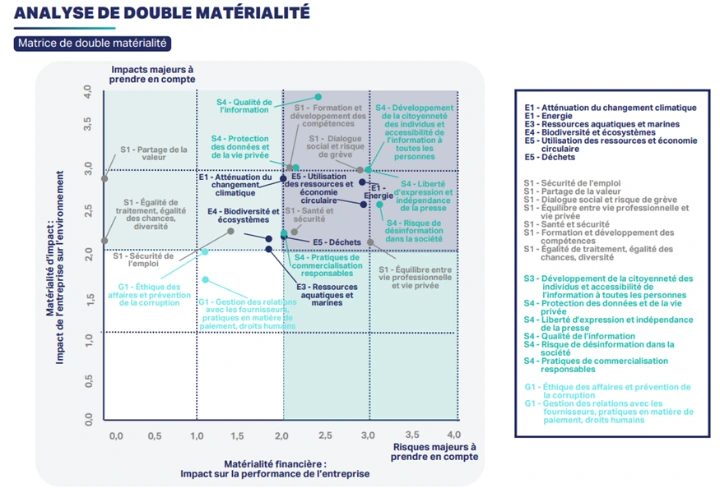
Double materiality matrix: analysis tool that evaluates sustainability issues from two angles — the company's impact on its environment (impact materiality) and the impact of sustainability issues on financial performance (financial materiality).
IRO: the set of effects that a company generates or experiences regarding sustainability — impacts, risks, and opportunities — that the CSRD requires to be identified, analyzed, and prioritized.
The 5-step methodology
Positive Company® supported the EBRA Group in formalizing its double materiality matrix in 5 major steps.
Contextualization of the activity and the stakes
The first phase consisted of a thorough analysis of the value chain of the EBRA Group (key activities, stakeholders, resources involved at each stage) to identify the most significant sustainability issues upstream and downstream. A mapping of stakeholders was then carried out to prioritize them according to their importance to the company.
Step 2: Preliminary research work
A comparison of peer practices was conducted to understand the ESG maturity of the sector, identify best practices, and gain an in-depth view of the issues in the press. This research incorporated industry standards (SASB, Global Risk Report) and targeted studies, including a report commissioned by the advertising agency 366 on regional daily press, conducted by Positive Company®.
Based on this data, an initial list was developed, completed, and validated by the project team to result in 47 IRO.
Step 3: Qualitative interviews
In accordance with the recommendations of the CSRD, the Group conducted interviews with its key stakeholders — internal (HR, management, employees, journalists, employee representatives) and external (suppliers, advertisers, subscribers) — to gather detailed opinions on the IROs, their timing, scope, and likelihood.
Step 4: Quantitative surveys
To prioritize the IROs in order of importance, 400 stakeholders were surveyed through quantitative surveys, allowing for the assessment of the relative importance of each IRO identified upstream.
Step 5: Consolidation and construction of the matrix
The final phase consisted of analyzing and integrating the results of quantitative and qualitative surveys. The EBRA Group and Positive Company® prioritized the IROs and determined the materiality threshold, resulting in 58 final IROs and the double materiality matrix.
The 3 pieces of advice from the EBRA Group to get started
Drawing on its experience, the EBRA Group shares three essential pieces of advice:
Anticipate: 12 months is not too long to structure the approach and conduct a thorough analysis
Getting support: external assistance is necessary to successfully carry out a project of this magnitude
Embrace continuous improvement: the CSRD is not a one-time project but an evolving process of ESG integration
"The support from Positive Company® has been a true lever to transform a regulatory requirement into a strategic opportunity. Far beyond technical and methodological expertise, it is their deeply human approach that made the difference. Their ability to listen, understand our specificities, and engage all stakeholders has been crucial."
Rémy Ramstein, Industrial Director, Purchasing and CSR of the EBRA Group
Who is Ebra?
Company Information
A 100% subsidiary of Crédit Mutuel Alliance Fédérale, the EBRA Group is the leading regional daily press group in France. It owns nine regional dailies distributed in 23 departments in Eastern France: Le Dauphiné Libéré, Le Progrès, les Dernières Nouvelles d'Alsace, l'Est Républicain, le Républicain Lorrain, le Bien Public, le Journal de Saône et Loire, l'Alsace, and Vosges Matin.
Faced with the extra-financial reporting requirement of the CSRD, the Group chose to go further than mere compliance: to create its own double materiality matrix and its own sustainability report, supported by Positive Company®.
Key figures
1
58
number of IRO (Impacts, Risks, and Opportunities) defined by the EBRA Group
2
400
number of stakeholders interviewed for the realization of the double materiality matrix
Conclusion
The approach of the EBRA Group illustrates what the CSRD can produce when it is viewed as an opportunity rather than a constraint: a structured analysis of 58 IROs, consultation with 400 stakeholders, the involvement of the COMEX from the outset, and a sustainability report built independently. A transformation that begins with a choice: to go further than what the regulations require.
Does your organization need to comply with the CSRD or wish to create its double materiality matrix?
Positive Company® supports companies in their CSRD approach — from contextualizing the issues to building the matrix, with a human and tailored approach.
Discover the Positive Company® Label ? En savoir plusFAQ: Ebra x Label Positive Company®
The CSRD (Corporate Sustainability Reporting Directive) is a European directive that requires certain companies to publish a report detailing their main impacts, risks, and opportunities (IRO) regarding sustainability — environment, social, governance. Since the Omnibus package (March 2026), the scope has been narrowed to companies exceeding 1,000 employees AND €450 million in net revenue. The companies concerned must publish this information according to ESRS standards.
The double materiality matrix is an analytical tool that evaluates a company's sustainability issues according to two complementary dimensions: impact materiality (how the company affects its environment and society) and financial materiality (how sustainability issues can affect the company's financial performance). It is the foundation of the CSRD and one of the most demanding exercises of the approach.
Three pieces of advice from the Group's experience: anticipate (12 months is not too much), seek support from an external provider to structure the approach, and accept continuous improvement — the CSRD is not a one-time project but an evolving process of ESG integration into the company's strategy.
Rather than simply meeting the CSRD requirement at a minimum level, the Group chose to create its own double materiality matrix and to write its own sustainability report — with the involvement of the COMEX from the start and the consultation of 400 stakeholders. This approach produced 58 prioritized IROs and allowed for the transformation of a regulatory obligation into a strategic opportunity.