
Reading time: 8 minutes
Article published in July 2025, updated in August 2026
In this article, you will discover :
- How Damartex recycles 55 tons of textile scraps each year thanks to the RECYLACTYL project; a first in the recycling of Thermolactyl
- How the group has decarbonized its logistics with combined boat-train transport between Tunisia and Hauts-de-France: 585 kg of CO₂eq saved per trip
- How Damart extends the lifespan of its clothing through a partnership with Les Réparables
Sollicité par La Redoute dans le cadre de Scoring by PositiveRequested by La Redoute as part of Scoring by Positive, Damartex, a major player in the Silver Economy for 70 years, achieved the Gold 2025 score with a rating of 67.3/100, an increase of +6.75 points compared to 2024. A result that crowns a sustainable transformation carried out across the entire production chain: recycling textile scraps with the RECYLACTYL project, decarbonizing logistics through combined boat-train transport, and developing textile repair with Les Réparables.
Production: from waste to resource with the RECYLACTYL project
Damartex launched in July 2024 the project RECYLACTYL, an initiative aimed at reducing the environmental impact of the production of its Thermolactyl. Each year, nearly 55 tons of textile scraps, equivalent to 200,000 t-shirts, were previously discarded. Thanks to RECYLACTYL, these waste become a new resource.
Vocabulary point:
Mechanical recycling: a process that involves recycling textile materials through physical means (grinding, shredding, re-spinning), without chemical transformation. More ecological but technically more demanding, as it can weaken the fibers and the properties of the final textile.
Circular sector : value chain organized around the principle of the circular economy, where the waste from one production process becomes the raw material for another, rather than being discarded.
CETI (European Center for Innovative Textiles) : French research and innovation center dedicated to the development of new textile solutions, particularly on the issues of eco-design and recycling.
A conclusive first phase
The first phase of the project demonstrated the feasibility of recycling a textile already composed of 50% recycled fibers, without compromising its thermal properties or its strength. A challenge successfully met despite the constraints of mechanical recycling, supported by the European Center for Innovative Textiles (CETI).
Towards new products and a public commercialization
Building on these results, Damartex plans to use the fiber from RECYLACTYL to manufacture other products — socks, down jackets, thermal clothing — with a public launch starting in winter 2026 in France, the United Kingdom, and Belgium. A proof that the circular economy can be sustainably integrated at the heart of product innovation.

Logistics: decarbonizing the chain with combined boat-train transport
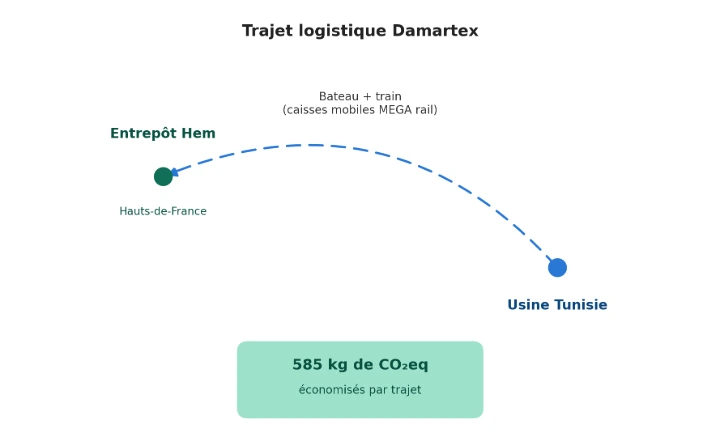
In collaboration with M&M Militzer & Münch France, Damartex launched in June 2024 a new mode of combined transport (boat + train) to connect its factory in Tunisia to its logistics warehouse in Hem, in the Hauts-de-France.
A measurable result from the first trip
Result: 585 kg of CO₂eq saved per trip, thanks to the use of MEGA rail mobile boxes.
This solution was generalized from the autumn/winter 2024-25 season for the supply of Thermolactyl underwear. It is the result of a collective effort involving the teams from M&M Halluin, the Tunisian factory, Impex Damart, and the French warehouse.
Usage: extend the lifespan of clothing with Les Réparables
Reducing your environmental footprint also means avoiding waste. It is with this in mind that Damart launched a partnership with Les Réparables, a French workshop specialized in textile repair.
A dedicated platform for repair
Since the summer of 2024, customers can have their Damart pieces repaired through a dedicated platform, while benefiting from the repair bonus implemented at the national level.
An event to mark the launch
To mark the launch, an event was organized at the Damart Lille Faidherbe store: for two days, the tailors from Les Réparables brought back to life for free the clothes brought in by customers — an experience that generated rich exchanges and real awareness.
Clarification on the scope of the case study
The actions described in this case study concern exclusively Damart, one of the flagship brands of the Damartex group (which represents 68 % of the Group's revenue in 2024-2025), specialized in innovative and technical ready-to-wear. They are part of the overall CSR strategy led by the group.
Who is Damartex?
Company Information
With 70 years of expertise in the senior market, Damartex establishes itself as a major player in the Silver Economy. The group is structured around 3 complementary poles:
- Damartex Fashion (Damart and Xandres)
- Damartex Home & Lifestyle (3Pagen, Coopers of Stortfort and Vitrine Magique)
- Damartex Healthcare (Almadia, Santéol and Msanté)
Located in 5 countries, Damartex relies on a team of over 2,500 employees.
Requested by La Redoute as part of Scoring by Positive®, Damartex obtained the Gold 2025 score with a rating of 67.3/100, an increase of +6.75 points compared to 2024.
Key figures
1
67.3/100
in 2025 at the Scoring by Positive® evaluation (+6.75 points vs 2024)
2
55 tons
of recycled textile scraps each year (RECYLACTYL project)
3
585 kg
of CO₂eq saved per trip (combined boat-train transport)
Conclusion
With its Gold 2025 score obtained through Scoring by Positive®, Damartex illustrates that a sustainable transformation of the production chain is possible at every stage: upstream recycling with RECYLACTYL (55 tons of scraps valorized), decarbonization in transit with combined boat-train transport (585 kg of CO₂eq saved per trip), and extending the lifespan of products downstream with Les Réparables. Three levers, one conviction: the circular economy can be integrated into the very heart of the industrial model.
Are you a buyer and want to assess the CSR performance of your suppliers?
Scoring by Positive supports clients in deploying customized evaluations — without charging the process to your suppliers.
Discover Scoring by Positive® Learn moreFAQ: Damartex x Scoring by Positive®
RECYLACTYL is a project launched by Damartex in July 2024 to recycle the textile scraps generated by the production of its Thermolactyl underwear. Each year, nearly 55 tons of scraps — the equivalent of 200,000 t-shirts — were previously discarded. Thanks to this project supported by CETI, these waste materials are transformed into new fiber, usable for other products (socks, down jackets, thermal clothing), marketed as early as winter 2026.
No. The first phase of the RECYLACTYL project demonstrated the feasibility of recycling a textile already composed of 50% recycled fibers, without compromising its thermal properties or its strength — despite the technical constraints inherent in mechanical recycling (grinding, shredding, re-spinning). It is precisely this challenge that the project successfully met, in collaboration with the European Center for Innovative Textiles.
In June 2024, Damartex launched, with M&M Militzer & Münch France, a combined boat-train transport to connect its Tunisian factory to its warehouse in Hem in the Hauts-de-France. Thanks to the use of MEGA rail mobile containers, each trip saves 585 kg of CO₂eq compared to traditional road transport. This solution has been rolled out starting in the autumn/winter 2024-25 season.
To reduce CO₂ emissions related to sourcing from Tunisia. The combined boat-train transport allows for part of the road journey to be replaced by less emitting modes, while maintaining supply reliability. The result is measurable from the first trip: 585 kg of CO₂eq saved, a solution that directly fits into Damartex's logistics decarbonization strategy.