
Reading time: 7 min
Written by Manoëlle Dousson
You have defined an ambitious CSR strategy, implemented actions, perhaps even earned a label or published a non-financial report... but the feedback is lukewarm, or silent. It may be less a fundamental issue than a perception problem. And the good news is that it can be worked on.
At Positive Company, we often observe a gap between the actual CSR efforts made by an organization and what its stakeholders - partners, clients, suppliers, employees, and even shareholders - perceive.
How do we measure stakeholders' perception of its CSR strategies?
Qualitative methods | Quantitative methods |
| NPS (via questionnaires with the Likert scale conducted by Positive Company): number of responses "strongly agree" and "agree" / number of responses |
CSR is not decreed, it is shared
Share, communicate, and live your CSR strategy
CSR is based on a promise: to be more responsible in its practices. But this promise is only valuable if it is credible and shared. A negative or simply vague perception can quickly undermine trust. When stakeholders do not understand or see your actions, they may develop a form of silent distrust: they watch you act... but without following or understanding.
Involve your stakeholders
This is even more evident for large companies: the larger the company, the more difficult it is to share its CSR efforts. Therefore, all stakeholders, both internal and external, must feel involved. An employee who does not understand the approach will not communicate it. A supplier not involved will not integrate it. A customer who sees no benefit will not change their behavior.
Communicate, in the right place, at the right time
Membership is not automatic. While the target may be right, the location may not be, or the timing may be inappropriate. The message, aligned with the strategy, must be tailored to the expectations or constraints of the recipients. And for that, it requires listening, adjustment, test & learn... and a toolbox of useful ideas.
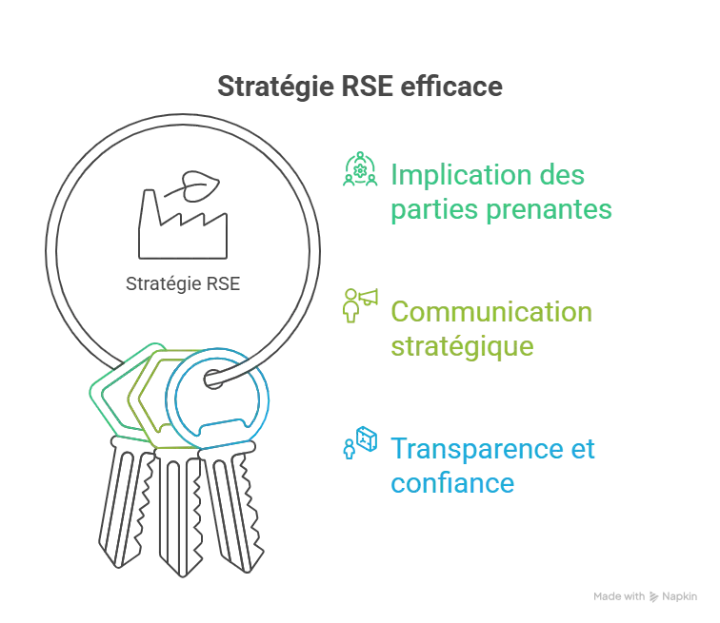
Your CSR only exists if your stakeholders perceive it
Make your commitments visible in real life
One of the main pitfalls of CSR lies in the gap between the efforts actually made and what is perceived by stakeholders. Many initiatives remain under the radar because they are not seen as tangible.
However, the credibility of an approach relies on concrete and visible evidence:
- tangible operational changes (reduction of packaging, improvement of working conditions, decrease in emissions…)
- measurable and verifiable results,
- and initiatives that are embodied in products, services, or daily interactions.
In other words, CSR actions must come out of the confidentiality of internal committees to be part of the lived experience of customers, employees, and partners.
👉 Thus, Espace PHR has replanted 3,070 trees through its plan; for each PHR Natio or PHR Complément’R, Espace PHR commits to planting 10 trees in the regions: a tangible environmental gain and a strong message sent to readers.
Link your CSR to your territory and your employees
CSR does not exist in a vacuum, even if it is communicated: it takes on its full meaning within the tangible framework of a territory and a human collective. The same commitment will not have the same resonance depending on whether it applies to a neighborhood, a city, a region, or an industry..
At the same time, involving employees in this collective anchoring is essential. Valuing personal commitments, encouraging local initiatives, and involving employees in projects helps transform CSR into a lever of pride and internal cohesion.
👉 Evolvia, a consulting firm in organizational transformation, illustrates this dual logic by involving its employees in local actions and creating bridges with a local primary school to raise students' awareness of entrepreneurship.
Prove your CSR to build trust with your stakeholders
Mobilize the ecosystem: involve suppliers, partners, and customers in your approach
A credible CSR is a shared CSR. Involving suppliers, partners, and service providers helps strengthen the grounding of your commitments.
-
Comexposium,
a global player in organizing professional and public events, has thus deployed a commitment charter tailored to its different categories of stakeholders.
- Evolvia launched its first stakeholder committee, linking social, environmental, and societal aspects, with a discussion around their CSR strategy.
👉 Winning strategy: moving from an "internal" CSR to an ecosystem CSR, where each actor contributes and recognizes themselves.
"We created our first stakeholder committee. This allowed us to directly obtain the perception of our stakeholders on our CSR strategy. The organization enabled us to gather qualitative information about our strategy and thus implement our continuous improvement plan."

Rethink your communication: tell your evidence, make it known
CSR actions are concrete and real, but many companies fear being labeled as greenwashing and prefer to remain discreet.
Communication is neither a luxury nor a veneer: it is a strategic lever for building credibility. When done well, it allows for:
- to make sometimes complex actions understandable,
- to translate commitments into concrete evidence,
- to adapt the message according to the audiences (clients, employees, investors, partners),
- and to show the coherence between the mission, the strategy, and daily practices.
This can be reflected in particular by highlighting the obtained labels, which are demanding and recognized in the industry.
👉 At Comexposium, the arrival within the Group Communication and CSR Department of a Communication and Engagement Manager aims to further structure the impact discourse and strengthen the mobilization of its stakeholders.
The ultimate tip: have a strong and clear mission
Beyond occasional actions, what unites and provides visibility is the purpose. A clear mission acts as a strategic and symbolic compass.
Why is it essential to go beyond isolated CSR actions?
"Isolated actions can have an impact, but they are not enough to provide direction. What unites and gives clarity is the purpose. A clear mission acts as a strategic and symbolic compass. Without it, commitments may seem scattered, opportunistic, or defensive."Specifically, what role does the mission play at Quanta?
"Our mission is explicitly stated: to raise public awareness of the richness of Artistic Expression through our activities as a theater company and cultural action, and to offer a catering service as support for the integration of individuals welcomed within the ESAT. Everyone who gets involved with us knows our motivations from the very beginning. And thus, our CSR vision as well. This common thread allows us to align our projects, facilitate communication, and inspire our collaborators."
In conclusion
If your stakeholders do not perceive your CSR commitments, it does not mean that you are not acting... but that you are unable to show it.
The solution lies in three horizons:
Short term: better communicate your existing actions.
Medium term: involve your stakeholders in decisions and evidence.
Long term: build a clear mission and a sustainable foundation.
And above all, do not hesitate to open the discussion. In many cases, your partners will be happy to co-create a more readable, more impactful, and more sustainable CSR with you.
This article stems from the Café des labellisés on September 2, 2025, thanks to: